

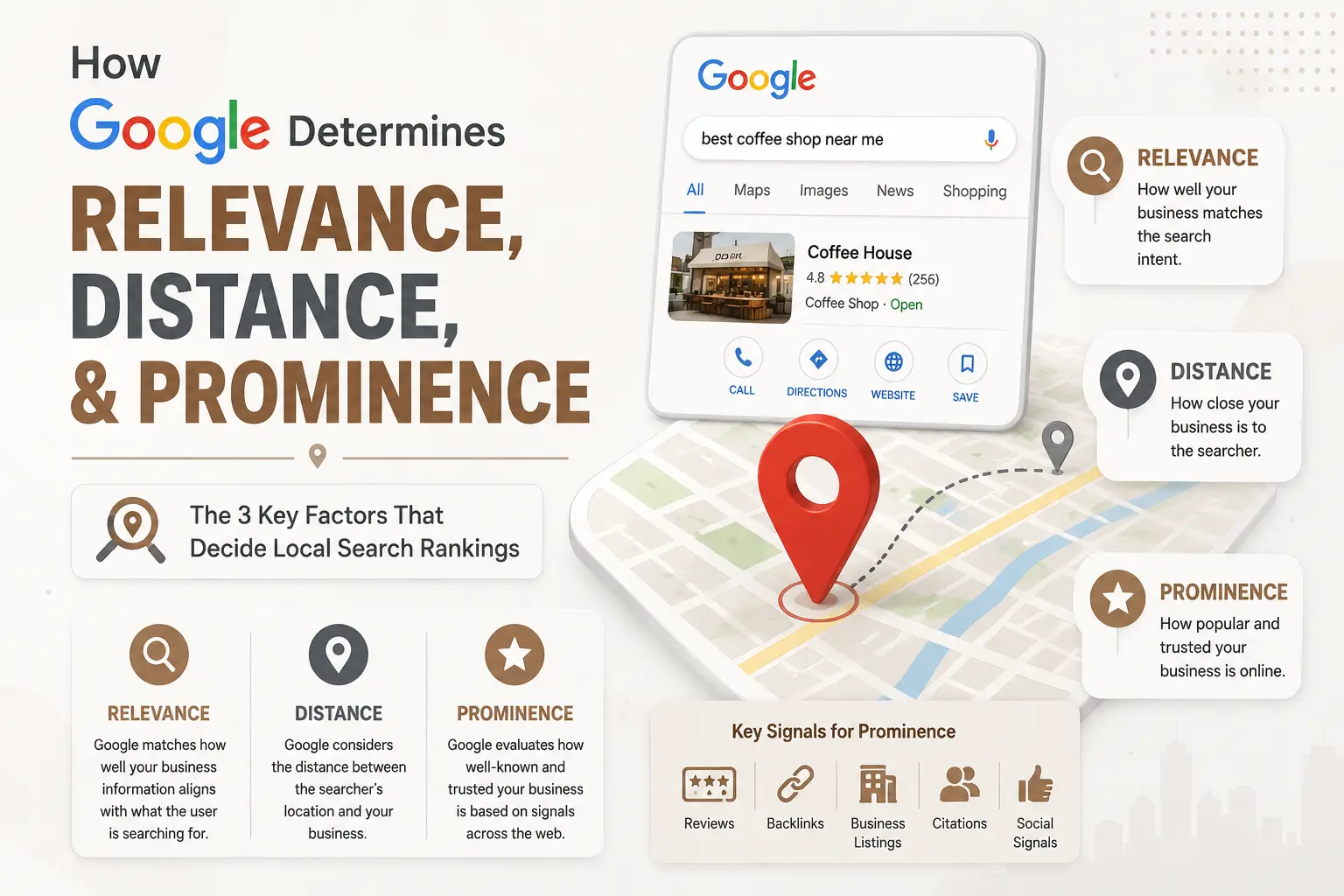
Have you ever wondered why some businesses show up on Google, and others do not? You might have a great business, but your competitor keeps appearing above you in search results. It feels frustrating, especially when you know your service is better than theirs.
The answer almost always comes down to three factors: relevance, distance, and prominence. Google uses all three to decide which businesses appear in the local search results and Map Pack. Understanding how each one works gives you a real advantage over every competitor in your area.
In this guide, we are breaking down each factor clearly and simply. By the end, you will know exactly how Google evaluates your business and how to improve your rankings fast.
What Is the Google Local Search Algorithm?
Google’s local search algorithm is different from its regular web search algorithm. When someone searches for a local business, Google activates a specialized local ranking system. This system evaluates nearby businesses and decides which ones deserve to be shown first.
The results appear in two main places: the Google Map Pack and the regular organic results. The Map Pack is the box of three local businesses that appears near the top of the search results page. Getting into that Map Pack is one of the most valuable things a local business can do online.
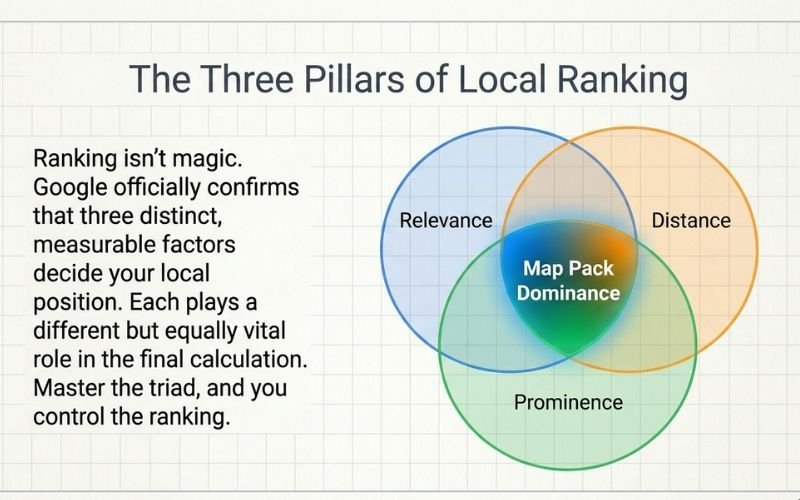
Google officially confirms that three factors determine local rankings. Those three factors are relevance, distance, and prominence. Each one plays a different but equally important role in your final position.
Factor One — Relevance
What Is Relevance in Local Search?
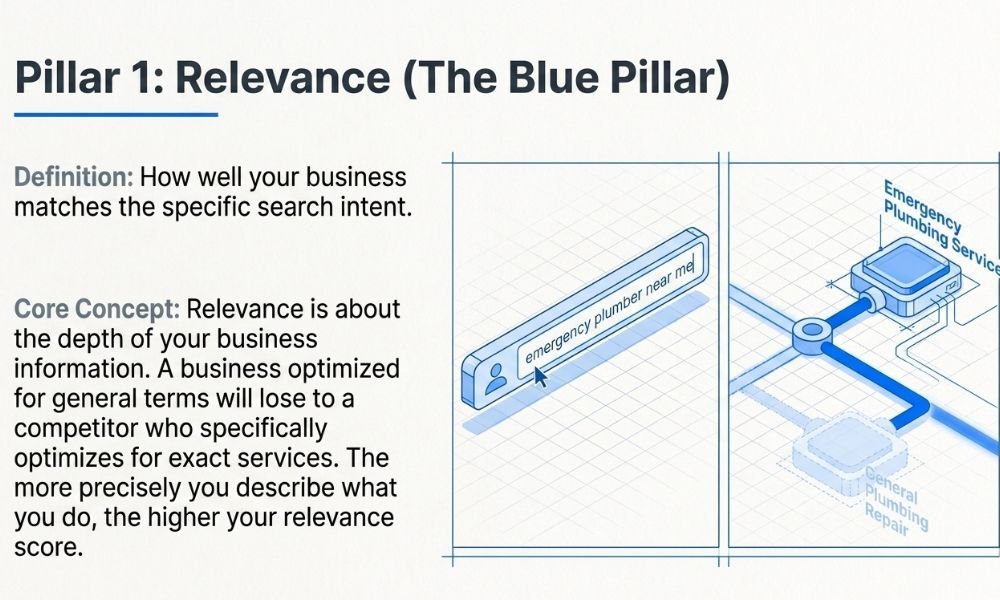
Relevance is about how well your business matches what someone searched for. If someone searches “emergency plumber near me,” Google looks for businesses that clearly offer emergency plumbing services. A business that only mentions general plumbing repair may rank lower than a more specifically optimized competitor.
Relevance is not just about your business category; it is about the depth of your business information. Google reads your Google Business Profile, your website, your services listed, and your content to determine relevance. The more precisely and thoroughly you describe your services, the more relevant Google considers your business to be.
What Signals Affect Relevance?
Several clear signals directly influence how relevant Google considers your business to be.
Your Google Business Profile categories are the single strongest relevance signal you have. Choosing the most accurate primary category — and adding all relevant secondary categories is essential.
Your business description matters more than most people realize. Write a clear, keyword-rich description that explains exactly what you do and who you serve. Do not use filler language or generic descriptions that could apply to any business in your industry.
Your listed services and products also communicate relevance directly to Google. List every service you offer with clear, descriptive names and accurate descriptions. This tells Google exactly what your business does and when to show it in search results.
Your website content reinforces the relevance signals from your Google Business Profile. A well-optimized website with service-specific landing pages, location pages, and blog content sends strong relevance signals. When your GBP and website agree and reinforce each other, your relevance scores improve significantly.
How to Improve Your Relevance Score
Start by auditing your Google Business Profile and making sure every section is fully and accurately completed. Check that your primary category is as specific as possible for your exact type of business. Add all secondary categories that honestly apply to your services.
Write a detailed and keyword-rich business description using natural, human language. List every service you offer using the services section inside your Google Business Profile. Add photos that visually communicate what your business does and the quality of your work.
On your website, create individual landing pages for each major service you offer. Use specific language that matches how your customers actually search for your services online. This alignment between your GBP and website is one of the fastest ways to improve local relevance.
For expert help optimizing your Google Business Profile and improving your local relevance. Explore our Google Business Profile optimization service.
Factor Two — Distance
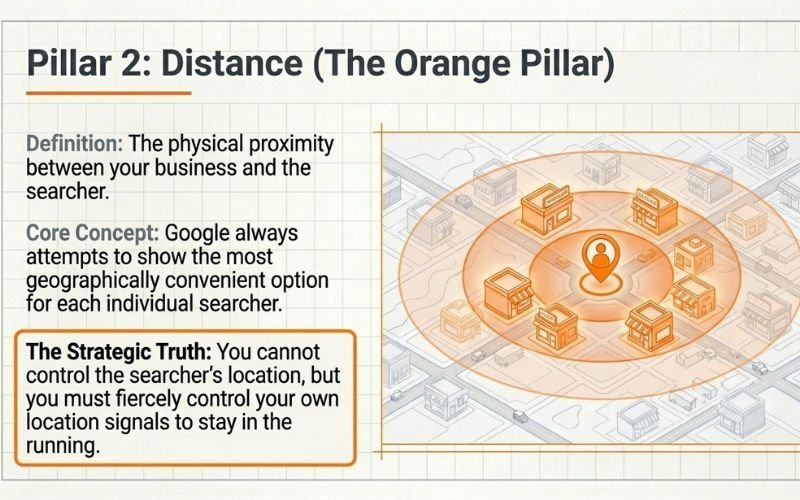
What Is Distance in Local Search?
Distance refers to how far your business location is from the person who is searching. Google measures the physical distance between the searcher and every potentially relevant local business. Businesses that are closer to the searcher generally have a geographic advantage in local search results.
This is why two people in different parts of a city can search the same phrase and see different results. Google is always trying to show the most geographically convenient options for each individual searcher.
Does Distance Always Win?
This is one of the most misunderstood parts of local SEO, and it is important to get this right. Distance is a significant factor, but it does not automatically override relevance and prominence. A highly relevant and prominent business that is slightly farther away can still outrank a closer but weaker competitor.
According to Moz’s Local Ranking Factors research, proximity is just one piece of a complex ranking equation. Businesses with strong GBP optimization, consistent reviews, and authoritative websites can compete effectively even with a distance disadvantage.
What this means practically is very important for your strategy. You cannot control where your business is physically located, but you can control relevance and prominence. Investing deeply in those two factors is how you overcome a geographic disadvantage in your market.
How Location Signals Affect Distance Rankings
Google uses several location signals to determine the distance component of your ranking.
Your business address as listed on your Google Business Profile is the primary distance signal. It must be accurate, consistent, and match exactly what appears on your website and across all online directories.
Your service area settings in Google Business Profile also influence how Google interprets your business location. If you serve customers beyond your immediate address, setting your service area correctly communicates that to Google.
The location of the person searching matters as well, and you cannot directly control that. What you can do is make sure your business information is perfectly accurate, so Google always finds and positions you correctly.
Consistent NAP data your business Name, Address, and Phone number across all online directories reinforces your location signals. Inconsistencies in your NAP data confuse Google and can cause your rankings to drop even when everything else is strong.
For businesses that serve multiple locations across a region, local SEO services can help you rank in each area effectively.
Factor Three — Prominence
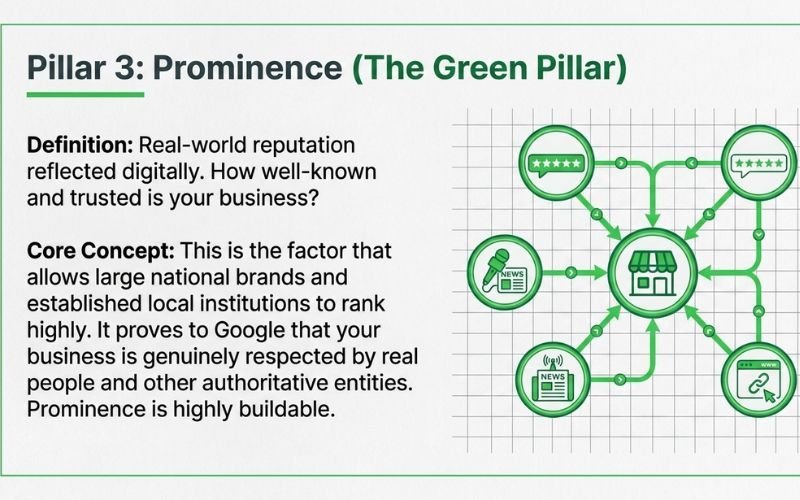
What Is Prominence in Local Search?
Prominence is about how well-known and trusted your business appears to be — both online and offline. Google tries to reflect real-world reputation in local search results, not just digital optimization. A business that is genuinely respected, widely reviewed, and frequently mentioned online ranks higher because of prominence.
This is why large national brands and established local institutions sometimes rank above newer businesses in the Map Pack. Their prominence has been built over the years through consistent customer experiences, reviews, and online mentions.
The good news is that prominence is absolutely buildable, and it builds faster than most business owners expect.
What Signals Build Prominence?
Prominence is made up of several interconnected signals that all work together.
Google reviews are the single most visible and powerful prominence signal for local businesses. The number of reviews you have, the overall star rating, and how recently reviews were posted all matter significantly. Google also reads the content of your reviews — relevant keywords mentioned by real customers boost your relevance and prominence simultaneously.
BrightLocal’s Local Consumer Review Survey consistently shows that reviews are among the top factors consumers use to evaluate local businesses. More genuine, recent, and detailed 5-star reviews directly translate into higher local search rankings.
Your website’s domain authority and backlink profile are also core prominence signals. Google evaluates how many other authoritative websites link to your business website. Earning backlinks from local news outlets, industry directories, community organizations, and local business associations builds prominence effectively.
Local citations across trusted directories like Yelp, Facebook, Apple Maps, Bing Places, and industry-specific sites contribute to prominence as well. The more consistently your business is mentioned across reputable platforms, the stronger your prominence signal becomes.
Your overall online visibility beyond Google also matters. Mentions in local newspapers, community blogs, podcast appearances, and press releases all contribute to Google’s assessment of your business prominence.
How to Improve Your Prominence Quickly
Build a consistent and systematic review generation process into your daily business operations. Ask every satisfied customer to leave a Google review and make it easy by sharing a direct review link. Respond professionally to every review you receive, both positive and negative. Thoughtful responses show Google and future customers that your business is active, engaged, and customer-focused.
Build local backlinks by partnering with local chambers of commerce, community organizations, and relevant industry directories. Create genuinely useful content, blog posts, guides, and how-to articles that other local websites and publications want to link to. Every high-quality backlink that points to your website increases your domain authority and strengthens your prominence.
Keep your NAP data consistent across every online platform where your business is listed. Audit your citations regularly to find and correct any inconsistencies that may be weakening your prominence signals.
For businesses that want to build prominence quickly and systematically, our content marketing service creates authoritative, linkable content that builds your online reputation month after month.
How Relevance, Distance, and Prominence Work Together
Understanding each factor individually is important, but understanding how they interact is even more powerful. Google does not rank businesses based on a single factor in isolation. Instead, it weighs all three together and delivers the result it believes will best serve the searcher.
Think of it this way. A business with exceptional prominence and outstanding relevance can rank above a closer but weaker competitor. A business with perfect proximity but poor relevance and almost no reviews will struggle to rank even for nearby searchers. The businesses that consistently win the Map Pack are the ones that are strong across all three dimensions simultaneously.
This is why a holistic local SEO strategy always outperforms a narrow focus on just one or two signals. You need to optimize your Google Business Profile for relevance. You need to earn reviews for prominence. You need accurate location data for distance. All three working together is what puts you at the top and keeps you there.
Common Mistakes That Hurt Your Local Rankings
Many businesses unintentionally damage their rankings by making avoidable mistakes across these three factors.
Choosing a vague or incorrect primary category on Google Business Profile weakens your relevance significantly. Leaving your business description incomplete or generic misses a major opportunity to communicate exactly what you do. Inconsistent NAP data across online directories creates conflicting location signals that confuse Google’s distance assessment. Ignoring review generation allows competitors to build prominence while your business stays relatively unknown. Having a slow, mobile-unfriendly website weakens both your relevance signals and your overall prominence in Google’s eyes.
Each of these mistakes is fixable and fixing them often produces noticeable ranking improvements within weeks.
The Role of Your Google Business Profile in All Three Factors
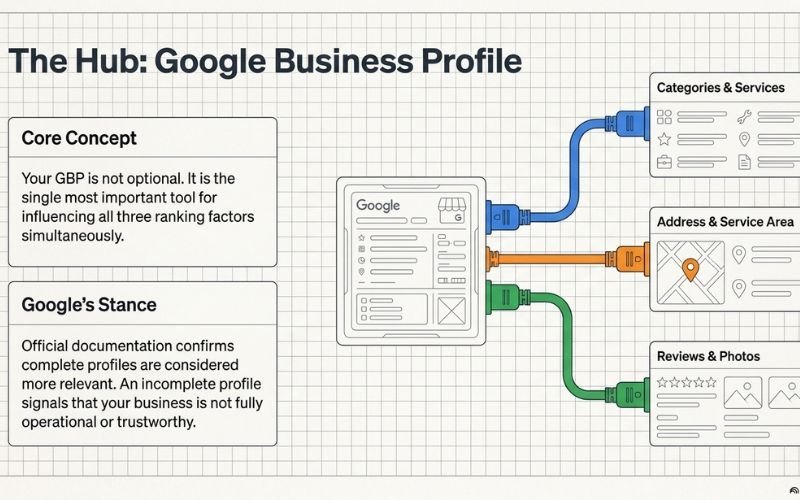
Your Google Business Profile is the single most important tool you have for influencing all three ranking factors. It directly impacts relevance through your categories, services, and description. It impacts distance through your address and service area settings. It impacts prominence through your reviews, photo count, and posting frequency.
A fully and expertly optimized Google Business Profile is not optional for local businesses in competitive markets. It is the foundation of everything else you do in local SEO.
Google’s own documentation confirms that businesses with complete and accurate profiles are considered more relevant in local search. An incomplete or neglected profile sends the opposite signal that your business may not be fully operational or trustworthy.
Quick Action Plan to Improve Your Local Rankings
Here is a straightforward action plan you can start implementing immediately.
First, open your Google Business Profile and complete every single section thoroughly. Check your primary category and update it if a more specific option exists for your business type. Add all relevant secondary categories that honestly describe additional services you provide.
Second, rewrite your business description to be specific, keyword-rich, and genuinely helpful for searchers. List every service you offer in the services section with clear names and accurate descriptions. Upload at least 20 high-quality photos showing your team, your work, and your business location.
Third, create a simple system for consistently requesting Google reviews from satisfied customers. Send a direct review link via text or email right after a positive service experience. Respond to every new review within 24 hours, showing Google and customers that you are actively engaged.
Fourth, audit your NAP data across all major online directories and correct any inconsistencies you find. Make sure your website address, phone number, and business name match perfectly on every platform.
Fifth, invest in creating high-quality website content that earns backlinks and builds your authority over time. A well-optimized website with strong domain authority dramatically amplifies the work you do on your Google Business Profile.
If this feels like a lot to manage on your own, our team at 4P Wisdom handles all of this for local businesses every day.
Why Local SEO Is a Long-Term Investment Worth Making
Some business owners want instant results and PPC advertising can absolutely deliver that in the short term. Our performance marketing services are designed to do exactly that for businesses that need immediate lead flow.
But local SEO and Map Pack optimization build something that PPC cannot: lasting, compounding authority. Every review you earn, every backlink you gain, and every piece of content you publish compounds over time. The businesses that invest in local SEO consistently today are the ones dominating their markets two years from now.
Relevance, distance, and prominence are not a one-time fix — they are ongoing signals that require consistent attention. The businesses that treat local SEO as a continuous process — not a one-time project consistently win in competitive markets.
Final Thoughts
Google’s local ranking algorithm is built around one core goal: helping searchers find the best business for their specific need. Relevance tells Google what your business does. Distance tells Google where it is. Prominence tells Google how trusted it is. Your job is to be the strongest option across all three of those dimensions.
The great news is that every single factor is within your control. You can improve your relevance by optimizing your Google Business Profile and website thoroughly. You can signal your location accurately by keeping your NAP data consistent everywhere online. You can build prominence by earning reviews, creating great content, and getting mentioned across the web.