

Google Search is changing quickly, and the way people discover websites is changing with it. Users are no longer relying only on typed keywords to find information. They can now take a picture, upload an image, use Google Lens, or circle something on their phone and search for it.
That makes visual content more important for SEO.
On September 24, 2026, Google announced a new multimodal search reporting feature in Google Search Console. The update gives website owners more visibility into how their content performs when people discover it through image-based searches.
For SEOs, publishers, ecommerce businesses, and anyone who relies on organic search traffic, this adds another useful layer of data to Search Console.
What Is Multimodal Search?
Multimodal search allows users to search using more than traditional text queries. Instead of typing something like “black leather handbag,” for example, someone can take a photo of a handbag and use that image to search.
Google can then use the visual information in the image to understand what the person is looking for.
The new Search Console reporting covers several types of visual search activity, including:
- Google Lens searches
- Circle to Search on Android
- Image uploads to Google Search
- Chrome’s “Search this image” feature
This means your website may be appearing in search experiences that don’t start with a traditional typed keyword.
That’s important because your existing SEO reports may not tell the complete story of how users are discovering your content.
What Is New in Google Search Console?
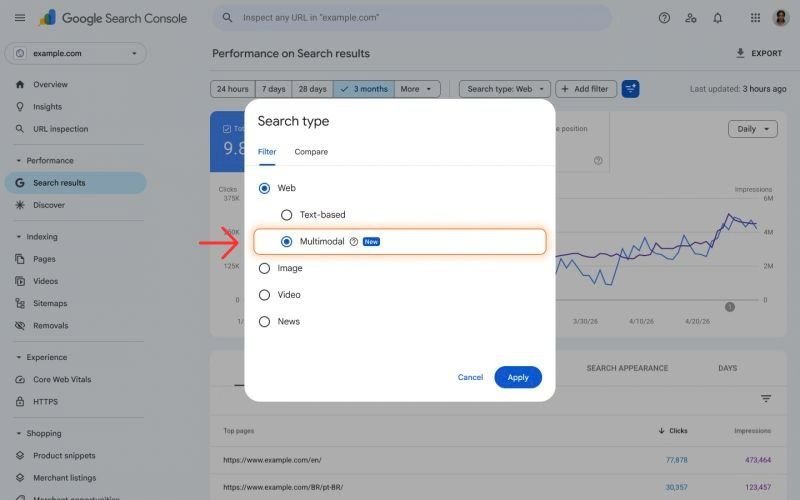
Google has added a new multimodal search type filter to its Performance reports.
This allows site owners to separate multimodal search performance from other search activity and analyze the data more closely.
You can use the filter inside Search Console’s Performance report to look at the available multimodal search data for your website.
Google also says the data can be exported, which is useful if you want to combine it with data from other SEO and analytics platforms.
For example, an SEO team could export the data and compare it with:
- Organic search performance
- Landing-page data
- Image optimization efforts
- Search queries
- Conversion data
- Content performance
This can make it easier to identify which visual assets are actually contributing to search visibility.
Why Does Multimodal Search Matter for SEO?
For years, SEO conversations have focused heavily on keywords, titles, headings, links, and written content.
Those things still matter, but search behavior is becoming more visual.
Think about how people search for products, places, clothing, cars, food, home designs, and other physical objects. Sometimes it is easier to show Google what you’re looking for than to describe it with words.
That’s where multimodal search becomes particularly interesting.
A business might have a product page that receives little traditional keyword traffic but still gets discovered through visual searches. Without dedicated reporting, that activity could be difficult to identify.
The new Search Console data gives SEOs another way to understand how their content is being surfaced.
How Should You Optimize for Multimodal Search?
Google’s announcement doesn’t mean you need to completely change your SEO strategy. Instead, visual optimization should become a stronger part of your existing strategy.
1. Use Descriptive Image File Names
Avoid uploading images with generic names such as:
IMG_4837.jpg
Instead, use descriptive filenames that accurately explain the image.
For example:
blue-running-shoes-side-view.jpg
The filename isn’t a magic ranking factor, but descriptive naming makes your images easier to organize and provides useful context.
2. Write Useful Alt Text
Alt text remains important for accessibility and helps search engines understand the subject of an image.
Write alt text that describes the actual image naturally.
For example, instead of:
“shoes”
you could write:
“blue running shoes with white soles on a wooden floor”
Don’t stuff keywords into alt text. Describe the image for someone who cannot see it.
3. Add Images That Support the Page
Don’t add images just because you want more images on a page.
The strongest visual content should help users understand the topic.
For example, an auto repair website could use original photos showing brake components, worn brake pads, diagnostic equipment, or technicians performing a specific service.
That type of visual content can provide useful context while making the page more helpful to visitors.
4. Use Relevant Surrounding Content
An image shouldn’t exist in isolation.
The heading, paragraph, caption, filename, alt text, and overall page topic can all help provide context.
If you’re publishing an article about brake rotor problems, an original photo of a damaged rotor should be surrounded by relevant information explaining what the user is looking at.
This creates a clearer connection between the image and the page.
5. Prioritize Original Visuals
Original photography can be particularly valuable for businesses.
A local company that regularly publishes its own photos can show real products, locations, projects, employees, equipment, or completed work instead of relying entirely on generic stock photography.
For local SEO, this can also help reinforce the real-world identity of a business.
Don’t Ignore the Generative AI Report
One interesting part of Google’s announcement is that multimodal search reporting is also being introduced in the report for Generative AI features.
This matters because search is increasingly combining traditional results with AI-driven experiences.
Rather than treating traditional SEO, image SEO, and AI visibility as completely separate strategies, businesses should start thinking about how their content can be understood across different search experiences.
Clear information, useful images, strong topical relevance, structured content, and trustworthy sources can all contribute to making a website easier for modern search systems to understand.
What Should SEOs Do Now?
The first step is simple: check Search Console.
If the multimodal search filter is available for your property and your site is receiving relevant traffic, look at the data and identify patterns.
Pay attention to which pages and visual assets are receiving exposure.
Then ask:
- Which pages appear in multimodal searches?
- What types of images are associated with those pages?
- Are original images performing better than generic visuals?
- Which topics generate visual discovery?
- Are important commercial pages properly optimized for image search?
- Can existing images be improved with better context and descriptions?
You don’t need to redesign your entire website overnight.
Instead, use the new data to find opportunities and improve the pages that are already getting visibility.
The Bigger SEO Picture
The introduction of multimodal reporting is another reminder that Google Search is no longer just about 10 blue links and typed keywords.
People are searching with text, images, cameras, screens, and increasingly AI-powered experiences.
For SEO professionals, that means understanding search behavior is becoming just as important as tracking keyword rankings.
The businesses that pay attention to how users actually discover their content will have more useful data to work with.
Google’s new Search Console reporting gives website owners another piece of that puzzle. If your site receives multimodal search traffic, use the data to understand what is being discovered, improve your visual content, and make your pages more useful for both people and modern search experiences.
Want to grow your website organically and attract more qualified visitors from Google? Our SEO services focus on improving your search visibility, creating useful content, targeting the right keywords, and building a stronger online presence. We use practical, proven strategies designed to deliver sustainable organic growth and help your business reach more potential customers through search.