


Most auto repair shop owners think about growth in one way. Get more cars through the door.
It is a reasonable instinct. More cars should mean more revenue. But chasing car count without addressing what you earn per visit is like filling a bucket with a hole in it. You keep working harder without the numbers catching up.
The smarter path to growth is increasing your average repair order value. When you earn more from each vehicle that already trusts you enough to visit, your revenue grows without the marketing cost of acquiring new customers. Your technicians become more productive. Your service advisors become more valuable. And your shop becomes genuinely more profitable.
This guide covers everything you need to increase your average repair order value. We will walk through what ARO is, what a good number looks like, why your shop might be underperforming, and exactly how to improve it in the next 30 days.
What Is Average Repair Order Value (ARO)?
Average repair order value, commonly called ARO, is the average dollar amount your shop collects from each repair order. It is one of the most important performance metrics in the auto repair industry.
ARO does not measure how many cars you see. It measures how much value you deliver and capture from each one. A shop seeing 80 cars per week with an ARO of $450 generates $36,000 in weekly revenue. The same shop with an ARO of $650 generates $52,000 from the identical car count. That $200 difference per vehicle adds up to more than $832,000 in additional annual revenue.
Understanding and improving your ARO can help your shop increase revenue from every customer. With the right auto repair shop marketing strategy, you can attract better-qualified customers and increase repair orders.
How to Calculate Your Average Repair Order
The calculation is straightforward. Divide your total revenue for a period by the number of repair orders completed in that same period.
ARO equals total revenue divided by total repair orders.
For example, your shop generates $180,000 in a month and completes 400 repair orders. Your ARO is $450.
Track this number consistently using your shop management software. Most platforms, including Tekmetric, Shop-Ware, and Mitchell 1, can generate this report automatically. If you calculate it manually, pull total sales from your accounting system and your repair order count from your service software.
Use the same date range and calculation method every time. Consistency makes your ARO trend data meaningful.
ARO vs. Total Shop Revenue
Total revenue tells you how much money came in. ARO tells you how efficiently you are earning it.
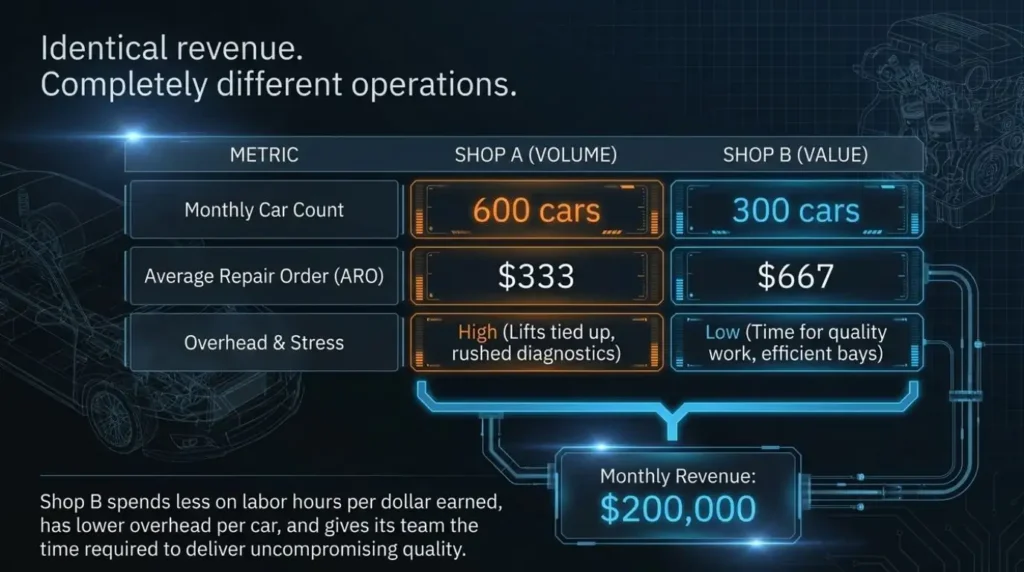
Two shops can generate identical monthly revenue with completely different AROs. Shop A sees 600 cars at an ARO of $333. Shop B sees 300 cars at an ARO of $667. Their revenue is the same. But Shop B spends less on labor hours per dollar earned, has lower overhead per car, and gives its team more time to deliver quality work on each vehicle.
Higher ARO is not just about money. It is about sustainability, efficiency, and quality.
A shop with a healthy ARO can afford to invest in better training, better equipment, and better customer experiences. A shop grinding through high car count at low ARO is often burning out its team while underdelivering on profit.
Why ARO Matters for Auto Repair Shop Profitability
Profitability in an auto repair shop depends on two levers: volume and value. Most shops default to chasing volume. Experienced shop owners learn to chase value first.
Here is why ARO matters directly for your bottom line.
Labor is your most valuable asset. A technician who completes a $200 repair uses the same lift bay as one who completes a $650 repair. The overhead cost is almost identical. The profit is dramatically different.
Parts gross profit scales with ARO. When you complete thorough inspections and recommend more legitimate services, your parts revenue grows alongside your labor revenue. Parts and labor gross profit together determine whether a shop makes money.
Shops with a higher ARO often build stronger customer retention because customers trust their recommendations. Effective lead generation strategies for auto repair shops should focus on transparency, clear communication, and genuine value. When customers feel confident in your advice, they are more likely to return and refer others.
What Is a Good Average Repair Order for an Auto Repair Shop?
No single universal ARO benchmark exists. Your ideal number depends on your market, your shop type, your labor rate, and your service mix. But there are useful ranges that can tell you where you stand.
Average ARO Benchmarks
Industry data from ALLDATA, the Automotive Service Association (ASA), and major shop management platforms consistently points to these ranges:
- General repair shops in most US markets: $350 to $500
- Well-managed general repair shops in competitive markets: $500 to $700
- Specialty repair shops or European vehicle specialists: $700 to $1,200 or more
- Quick lube and oil change-focused shops: $80 to $180
- Shops consistently using digital vehicle inspections and full estimate processes: $550 to $850
If your ARO falls below the range typical for your shop type, there is real money being left on the table with every repair order you write.
For shops in Houston, where the vehicle market includes a significant percentage of trucks, SUVs, and fleet vehicles, AROs trending toward the higher end of general repair benchmarks are achievable with the right processes in place.
Factors That Affect Your Shop’s ARO
Your ARO does not exist in isolation. Multiple factors push it up or down.
Labor rate: A higher labor rate increases ARO mathematically if you charge correctly. Many Houston shops undercharge relative to market rates and undermine their own profitability without realizing it.
Service mix: A shop that performs only oil changes will never have a high ARO. A shop that performs major engine, transmission, and brake work will have a naturally higher ARO even before any process improvements.
Inspection thoroughness: Shops that perform comprehensive digital vehicle inspections on every car consistently generate higher AROs than shops that only address the customer’s stated concern.
Customer communication quality: How well your service advisors explain recommendations directly impacts how many customers approve additional work.
Parts pricing: Using a consistent parts markup matrix rather than random or inconsistent pricing directly affects your parts gross profit and therefore your ARO.
Customer demographics: Shops serving older vehicles, high-mileage vehicles, or commercial fleet vehicles tend to have higher AROs because these vehicles have more maintenance and repair needs.
How to Find Your Current ARO Baseline
Pull your last three months of repair order data from your shop management software. Calculate ARO for each month separately. Then calculate the three-month average.
Three months gives you enough data to smooth out seasonal variation while still reflecting your current operations. One month of data can be skewed by a few unusually large or small jobs. Three months gives you a reliable baseline to improve from.
Record this number. Write it down or put it in a spreadsheet. You cannot improve what you do not track, and you cannot track what you have not measured.
Why Your Auto Repair Shop May Have a Low ARO
Before you can improve your ARO, you need to understand why it is where it is. Most shops with low AROs share one or more of these common problems.
Incomplete Vehicle Inspections
If your technicians only focus on the customer’s immediate concern, you may miss legitimate maintenance and repair needs. Most vehicles visiting an auto repair shop have additional service needs or deferred repairs the customer may not know about. Knowing how auto repair shop owners can dominate search can also help bring in more customers who need these services.
An oil change customer who also needs front brake pads, an air filter, and a cabin filter does not know they need those things unless someone inspects and communicates it to them. Without a systematic inspection process, that additional work leaves your shop on the customer’s vehicle. It may go somewhere else next time. Or it may lead to a breakdown that the customer blames on the shop that serviced it last.
Missed Maintenance and Repair Recommendations
Even shops that perform inspections often fail to recommend everything they find. Technicians may write up only what seems urgent. Service advisors may pre-filter recommendations they expect customers to decline.
Both habits cost your shop real money. According to AAA research, a majority of US vehicle owners report deferring maintenance because they were not aware their vehicle needed it. They were not told. If your shop told every customer about every legitimate maintenance need their vehicle has, your ARO would rise immediately.
Poor Customer Communication
A technician can find $1,200 in legitimate repair needs. If the service advisor cannot explain those findings clearly, confidently, and without pressure, the customer will approve only the minimum. Or nothing extra at all.
Poor communication includes using technical language customers do not understand. It includes presenting recommendations as a list rather than explaining why each item matters. And it includes failing to connect repair recommendations to safety, reliability, and cost of ownership consequences.
Low Parts or Labor Margins
Some shops have reasonably thorough inspection processes and decent customer communication. But their ARO still underperforms because they are not pricing parts and labor correctly.
A shop charging below-market labor rates or using inconsistent parts markup is doing the same work as a profitable competitor and earning less from it. Pricing strategy is a direct ARO lever that does not require any change in process or customer interaction.
Inconsistent Estimate and Approval Processes
If each service advisor handles estimates differently, you have no consistent floor for your ARO. One advisor might present five additional recommendations clearly. Another might mention one item casually at the end of the call. The variance between advisors creates an unpredictable ARO that is impossible to systematically improve.
Standardizing your estimate process, your script for presenting recommendations, and your method for following up on pending estimates eliminates this variance and creates a consistent ARO floor across all of your service advisors.
Declined Services Without Follow-Up
Every time a customer declines a recommended service, that work is not gone forever. It is deferred. The customer still needs that brake job. They still need that coolant flush. The question is whether they do it at your shop or someone else’s.
Shops without a systematic declined-service follow-up process are constantly losing this deferred work to competitors who do follow up. A simple 30-day or 60-day reminder call or text recovers a meaningful percentage of declined work and adds directly to your monthly ARO average.
10 Proven Ways to Increase Average Repair Order Value
1. Perform a Digital Vehicle Inspection on Every Vehicle
The single most impactful change most auto repair shops can make is implementing a consistent digital vehicle inspection (DVI) process on every vehicle, every time, without exception.
A digital vehicle inspection uses your technician’s phone or tablet to systematically photograph and document the vehicle’s condition. Every safety item, every maintenance item, and every deferred repair gets documented with photos and sometimes video.
Use photos and videos for every finding. A photo of cracked brake pads is worth more than a verbal description. Customers believe what they can see. Visual evidence removes doubt and eliminates the feeling that recommendations are fabricated.
Document safety and maintenance issues separately. Organize your inspection findings into safety-critical items, recommended maintenance, and future items to monitor. This prioritization helps customers make decisions without feeling overwhelmed by a long list.
Make inspection results easy for customers to understand. Use plain language in your inspection notes. “Front brake pads at 2mm, manufacturer minimum is 3mm” is more compelling than “front brakes worn.” Show the measurement. Show the comparison. Let the evidence do the selling for you.
Tools like Tekmetric, Bolt On Technology, Shop-Ware, and AutoVitals all offer digital inspection workflows built into their platforms. Implementation requires technician training and a commitment to consistency. But the ARO impact typically shows up within the first 30 days.
2. Show Customers What Their Vehicle Needs
Finding a problem is only half the job. Communicating it clearly is the other half, and it is where most shops fall short.
Explain the problem in plain terms. Customers are not mechanics. When you tell someone their serpentine belt is glazed and showing cracks, they hear a foreign language. When you say their belt is dried out and could snap while driving, leaving them stranded, they understand immediately.
Use visual evidence from the inspection. Text your customer the photos your technician took during the inspection. Walk them through what they are looking at. Show them the cracked belt, the low tire tread, the dirty air filter. Seeing their own vehicle’s condition is far more persuasive than any description you could offer.
Connect recommendations to safety, reliability, and money. Frame every recommendation around what matters to that customer. A parent of young children cares about safety above everything. A commuter cares about reliability. A budget-focused customer cares about avoiding the much larger repair that results from ignoring this smaller one now. Lead with the benefit, not the service name.
3. Recommend Complete Repairs Instead of Fixing Only the Immediate Problem
Addressing only the customer’s stated concern is a service failure, not a service standard. Customers bring their vehicles to you because they trust you to tell them what their vehicle needs. If you only fix the one thing they asked about and send them on their way with three other unaddressed issues, you have not served them well.
Look for related repair needs systematically. When replacing rear brake pads, inspect the rotors, calipers, and brake fluid while you already have the wheel off. When changing the oil, check the air filter, cabin filter, and wiper blades while the hood is open. Look for everything, document everything, and recommend everything that is legitimately needed.
Identify preventative maintenance needs. Use the vehicle’s service history in your shop management system and the manufacturer’s maintenance schedule from ALLDATA to identify upcoming maintenance items. A customer at 28,000 miles is approaching a 30,000-mile service. Flag it now and offer to complete it during this visit.
Consolidate multiple services into one visit. When a vehicle needs multiple services, consolidating them into one visit benefits the customer in time and convenience and benefits your shop in productivity and ARO. Present consolidated services as a time-saving option, not a pressure strategy.
4. Use Tiered Estimates and Service Options
Customers make better decisions when they have clear choices. Presenting a single price for a single option forces a yes or no decision. Presenting tiered options invites the customer into a conversation about what is right for their situation.
A tiered estimate might look like this.
Essential option: Address only the safety-critical item that cannot be deferred. This is the minimum the vehicle needs today to be safe. It is not the recommended path, but it respects the customer’s choice.
Recommended option: Complete the essential repair plus the maintenance items your inspection identified. This is what your technician recommends based on the vehicle’s condition. It represents full value for the customer.
Comprehensive option: Complete everything the vehicle needs, including upcoming maintenance and any items in the monitor category. This is the everything-taken-care-of option for customers who want to leave with peace of mind.
How to present options without pressuring customers: Always present the options neutrally and let the customer lead. Explain the consequence of each choice, not the price. A customer who chooses the essential option today may upgrade to the recommended option when they see it clearly explained. Customers who feel pressured decline more often and trust you less.
5. Improve Upselling and Cross-Selling the Right Way
Upselling and cross-selling can feel negative when customers see them as unnecessary pressure. But when recommendations are based on real vehicle needs and current car repair trends, they become a helpful part of customer care. The goal is simple: recommend the right service at the right time while keeping trust at the center.
Services that lend themselves to ethical cross-selling include:
- Routine maintenance services like coolant flushes, transmission fluid changes, and fuel system cleaning when the vehicle’s mileage and service history indicate the need
- Air filters and cabin filters, which are inexpensive and quick to replace
- Wiper blades, especially in spring and before rainy season
- Batteries, using a battery test during every inspection to document actual condition
- Bulbs discovered during a walk-around inspection
- Related components discovered during the primary repair, like a cracked hose found while replacing a water pump
Ethical upselling vs. unnecessary repairs: The test for every recommendation is simple. Would you recommend this service to a family member driving this vehicle? If yes, recommend it confidently. If the only reason you are recommending it is to add revenue, leave it off the estimate. Customers sense the difference over time, and trust is your highest-value long-term asset.
6. Improve Your Parts and Labor Pricing
Many shops with genuinely good inspection processes and strong customer communication still underperform on ARO because they are pricing parts and labor incorrectly.
Review your labor rate against your market. Research what comparable shops in your area of Houston charge per hour. If your rate is $20 to $30 below the market average, you are subsidizing every repair order. A labor rate increase of $20 per hour on a shop writing 400 repair orders per month at an average of 2.5 labor hours each adds $20,000 in monthly revenue. That is money you are currently leaving on the table.
Use a consistent parts markup strategy. Random or inconsistent parts markup creates unpredictable gross profit. A parts matrix sets markup percentages based on part cost brackets. Low-cost parts get a higher markup percentage. High-cost parts get a lower percentage. The result is consistent gross profit regardless of which parts any given repair requires.
Consider parts and labor matrices together. The most profitable shops use a combined matrix that prices parts and labor together as a unit.
Avoid unnecessary discounting. Discounting feels like a customer service move. It is actually a profit-destroying move. A shop that discounts 10% on average is writing off a significant portion of its potential ARO on every single repair order.
7. Make Estimate Approval Easier
A beautifully written estimate that sits in a voicemail is not helping your ARO. Customers in 2026 expect to receive, review, and approve estimates from their phones. Shops that make this easy get faster approvals and higher approval rates.
Send estimates by text and email simultaneously. Do not make customers call you back to hear the estimate verbally. Text them a link to a digital estimate they can open on their phone. Include an explanation of each item in plain language.
Include inspection photos and video clips with the estimate. When a customer sees the photo of their cracked brake pad inside the estimate link, the recommendation does not need a sales pitch. The evidence sells itself.
Make approval possible from the customer’s phone. They should be able to approve individual line items or the full estimate with a tap. The fewer steps between receiving the estimate and approving it, the higher your approval rate will be.
Follow up on pending estimates within two hours. An estimate sent but not reviewed within two hours warrants a friendly follow-up text or call. “I just wanted to make sure you received our estimate for your vehicle. Do you have any questions?” Most pending estimates that go unanswered are not decisions. They are customers who forgot to check their phone.
8. Train Service Advisors to Communicate Value
Your service advisors are the highest leverage position in your shop. A skilled service advisor who can communicate vehicle needs clearly, confidently, and empathetically will consistently generate higher AROs than an advisor who struggles to present recommendations.
Ask better opening questions. Instead of “What brings you in today?” try “Besides the oil change, have you noticed anything else with the vehicle lately? Any unusual sounds, warning lights, or performance changes?” This opens the door to additional concerns before the inspection even begins.
Listen to customer concerns before presenting solutions. A customer who feels heard is far more receptive to recommendations. Rushing past their concerns to get to the estimate damages the relationship and the ARO.
Explain recommendations in simple language. Every technical term you use is a barrier between the customer and a yes. Train advisors to translate mechanic language into customer language every time. Not “your serpentine belt shows glazing and lateral cracking.” Instead, “Your belt is starting to crack and dry out. If it snaps while you are driving, your car will stop immediately, and you will need a tow.”
Prioritize safety-critical work first. Safety items should always be presented first and with the greatest clarity. Customers almost universally want their families safe in their vehicles. Leading with safety removes the feeling that additional recommendations are optional.
Avoid aggressive sales tactics. High-pressure tactics may win a single approval. They will lose a customer for life. The goal is not the transaction. The goal is a customer who trusts your shop and returns for every vehicle they own.
9. Follow Up on Declined Repairs
Declined work is not dead work. It is deferred work. And the shop that follows up first usually wins the repair.
Create a declined-service list in your shop management system. Every service that a customer declines should be recorded in their vehicle file with the date, the mileage, and the reason for deferral if known. This list is money you have already found and simply have not captured yet.
Prioritize safety and maintenance items for follow-up. Declined brake work, worn tires, and emissions-related issues are the highest priority follow-up items. They matter most for the customer’s safety and have the most urgency attached to them naturally.
Send timely reminders. A text or email 30 days after a declined recommendation is not aggressive. It is helpful. The message should be simple: “When you were in last month, our technician noted your front brake pads were low. We wanted to follow up in case you wanted to get those scheduled before they wear further.”
Turn declined work into future appointments. When the customer is ready, make it effortless to book. Include a scheduling link in your follow-up message. Get them on the calendar while their intent is high.
10. Schedule the Customer’s Next Service Before They Leave
The most overlooked ARO-adjacent strategy is also the simplest. Schedule the next appointment before the customer walks out the door.
A customer leaving without a future appointment is a customer you need to re-acquire with marketing dollars. A customer with a scheduled appointment is already in your pipeline.
Use manufacturer-recommended maintenance schedules to set the next appointment. A customer picking up their vehicle after an oil change should be leaving with their next oil change appointment already booked based on their mileage interval and driving habits.
Schedule mileage-based reminders for upcoming major services. A customer at 58,000 miles should have a 60,000-mile service appointment in your system. Remind them by text as they approach the mileage.
Offer seasonal service scheduling. Summer AC checks in the spring, battery checks before winter, and tire rotations before peak driving seasons give you natural scheduling hooks that add ARO throughout the year.
Follow up on future repair items with a scheduled appointment. Any item placed in the “monitor” category during a vehicle inspection should have a specific return visit date associated with it. Give the customer a reason and a date to come back.
How Customer Experience Affects ARO
Customers do not approve additional repairs from shops they do not trust. Period.
If a customer has any doubt about whether your shop is being straight with them, they will approve the minimum and take their vehicle somewhere else next time. Customer experience and ARO are inseparable. You cannot maximize one without investing in the other.
Build Trust Before Recommending Additional Work
Trust is not assumed. It is earned with every customer interaction before the estimate is even presented. A clean waiting room, a warm greeting, prompt communication, and a technician who takes time to explain the inspection all build the foundation of trust that makes additional recommendations feel like help instead of hustle.
Keep Customers Updated Throughout the Repair
Nothing destroys trust faster than silence. A customer who dropped off their vehicle at 8 AM and hears nothing by noon begins to assume the worst. Keep customers updated at every stage. Text them when their vehicle goes into the bay. Text them when the inspection is complete. Text or call when their estimate is ready. Text them when their vehicle is done.
Proactive communication removes the anxiety that makes customers defensive about additional recommendations.
Use Text, Email, Photos, and Videos
Multi-channel communication consistently outperforms phone calls alone in estimate approval rates. Customers want to receive your estimate on their terms, read it at their own pace, look at the photos, and make an informed decision without feeling put on the spot.
Digital inspection platforms make this effortless when used correctly. Every photo your technician takes during the inspection becomes a trust-building element in your customer communication.
Make Pricing Transparent
A customer who receives a clear, itemized estimate with parts and labor broken out separately feels respected. A customer who receives a single bottom-line number with no detail feels suspicious. Transparency in pricing is a direct trust signal.
For your most complex estimates, consider a brief explanation of why each repair costs what it does. Not a justification, just a clear breakdown. Customers who understand what they are paying for approve more work.
Create a Convenient Approval Process
Every point of friction in your approval process costs you approved work. Phone tag, unclear estimates, and in-person-only approval processes are friction. Digital estimates with one-tap approval, photo evidence attached, and text-based follow-up are frictionless.
Make it easy to say yes, and you will hear yes more often.
How to Increase ARO Without Upsetting Customers
The fear of being seen as pushy is the reason many service advisors under-present recommendations. That fear is understandable but misplaced. Recommending legitimate services is the opposite of pushy. It is professional.
Focus on Education, Not Pressure
Your job is to inform, not to sell. Present what the vehicle needs. Explain why it matters. Then step back and let the customer decide. A customer who feels educated rather than pressured is far more likely to approve work and return to your shop.
Recommend Only Legitimate Vehicle Needs
Every recommendation should pass the family member test. Would you tell a family member driving this vehicle about this finding? If yes, you should tell your customer too. If not, leave it off the estimate. Recommending unnecessary services is both dishonest and self-defeating. Customers catch on. Reviews happen. Reputation is lost.
Explain the Consequences of Delaying Repairs
Customers who understand the consequences of delaying a repair make better decisions. Not because you scared them. Because they have the information they need. “This can wait a month, but by then the rotors will be damaged too, and the repair will cost about twice as much” is not a scare tactic. It is a fact that serves the customer.
Give Customers Choices
Never present additional work as all-or-nothing. Tiered estimates give customers control and agency. A customer who feels in control of the decision is far more likely to approve something than one who feels pressured into one option.
Let the Customer Make the Final Decision
After you have informed, explained, and answered questions, the decision belongs to the customer. Trying to overcome every objection destroys trust. State your recommendation clearly. Answer questions honestly. Then respect the customer’s choice. The relationship matters more than any single repair order.
How to Track and Improve Your ARO Over Time
Tracking ARO is what separates shops that improve intentionally from shops that improve by accident.
Track ARO Monthly
Calculate your ARO every month without exception. Record it. Compare it to the previous month and to the same month last year. Look for trends. Is it growing? Holding steady? Declining for a specific reason?
Monthly tracking gives you the frequency you need to identify problems and successes before they compound.
Compare ARO by Service Type
Your overall ARO is useful. Your ARO broken down by service category is even more useful. Brake repairs may average $520 while maintenance services average $180. Knowing this tells you where your biggest improvement opportunities are.
Most shop management platforms can generate ARO reports by job category. Use that data to focus your improvement efforts where they will have the most impact.
Track Estimate Approval Rates
Your estimate approval rate measures what percentage of recommended services customers actually approve. A shop with a 45% approval rate has room to improve. A shop with a 75% approval rate is communicating well and pricing fairly.
Track total approved dollars against total recommended dollars for each service advisor. This gives you coaching data at the individual advisor level.
Monitor Declined Services
Track the total dollar value of declined services each month. This is your deferred revenue pool. A shop declining $40,000 in recommended work per month has a significant follow-up opportunity sitting uncaptured.
Review declined services by advisor, by service type, and by customer to identify patterns. Certain service types may have consistently high decline rates suggesting a pricing or communication problem specific to those recommendations.
Track Digital Inspection Completion
If you have implemented digital vehicle inspections, track the percentage of repair orders that include a completed inspection. A DVI completion rate below 85% means a significant portion of vehicles are leaving your shop without a full opportunity to identify and recommend additional work.
This metric is a leading indicator of your ARO. If DVI completion rises, ARO typically follows within 30 to 60 days.
Measure Parts and Labor Gross Profit
ARO tells you the total ticket value. Parts and labor gross profit tells you how much of that value you actually keep. A high ARO with low gross profit margins means you are doing a lot of work for thin return.
Track parts gross profit margin and labor gross profit margin separately. Industry benchmarks from Mitchell 1 and the Automotive Management Institute suggest target parts margins of 45 to 55% and labor margins of 65 to 75% for well-managed shops.
Monitor Customer Retention and Repeat Visits
A rising ARO combined with declining customer retention is a warning sign. It may indicate that customers feel over-sold and are not returning. Always track ARO alongside retention metrics to ensure you are growing revenue through genuine value delivery.
Customers who return are customers who trusted you. Protecting that trust is what makes high ARO sustainable.
A Simple ARO Improvement Formula for Your Shop
Here is a practical framework to calculate the revenue impact of ARO improvement.
Current ARO: $420
Target ARO: $580
Monthly repair order count: 380
ARO improvement: $160 per repair order
Additional monthly revenue: 380 multiplied by $160 equals $60,800
A shop writing 380 repair orders per month that increases its ARO by $160 generates an additional $60,800 in monthly revenue. That is $729,600 in additional annual revenue from the same car count, the same team, and the same overhead.
This calculation should motivate every process conversation your shop has from here forward. ARO improvement is not about squeezing customers. It is about capturing the value that already exists in every vehicle that drives through your door.
Common Mistakes to Avoid When Trying to Increase ARO
Pushing Unnecessary Repairs
Recommending services a vehicle does not need is the fastest way to destroy your reputation and your ARO simultaneously. One customer who feels they were oversold will leave a negative review that costs you ten future customers. Every recommendation must be legitimate, documented, and something you would recommend to a family member.
Recommending Services Without Evidence
Verbal recommendations without visual or documented support feel like guesses to customers. Attach a photo or inspection finding to every recommendation. Show customers what you found. Give them evidence they can see and understand. Recommendations backed by evidence convert at dramatically higher rates than verbal descriptions alone.
Ignoring Customer Budget Concerns
A customer who mentions they are on a tight budget should never be pushed toward the comprehensive option. Listen to the concern, prioritize safety-critical work, defer non-urgent items with clear follow-up timing, and respect the customer’s financial situation. A customer you respect today returns next month.
Discounting Too Often
Discounting feels like generosity. Over time, it trains customers to expect discounts and signals that your pricing was inflated to begin with. Reserve discounts for specific strategic purposes: welcoming a new customer, recovering from a genuine service failure, or honoring a legitimate promotion. Do not discount as a default response to price questions.
Focusing Only on Revenue Instead of Profit
Revenue and profit are not the same thing. A shop that increases ARO by discounting on parts to add labor volume may actually decrease gross profit. Track your parts margin, labor margin, and net profit alongside your ARO to make sure your growth in revenue is also growth in profitability.
Failing to Follow Up on Declined Work
Declined services represent found work sitting uncaptured. Every month that passes without a follow-up system is a month that work may go to a competitor. Build your declined-service follow-up into your standard process, not as an optional extra.
Practical 30-Day Plan to Increase Your Auto Repair Shop’s ARO
Week 1: Establish Your ARO Baseline
Pull three months of repair order data from your shop management software. Calculate your ARO for each month and your three-month average. Break ARO down by service advisor and by service category.
Identify your current estimate approval rate and your monthly declined-service dollar value. Document your current labor rate and your parts markup approach. This baseline becomes your starting point and your measurement benchmark for everything that follows.
Week 2: Standardize Inspections and Recommendations
Implement or strengthen your digital vehicle inspection process. Train every technician on the inspection checklist and the photo documentation standard. Set a completion rate target of 90% or better and track it from day one.
Review your service recommendation language with your service advisors. Update your estimate templates to include clear, plain-language descriptions for your most common findings. Connect each finding to its consequence for safety, reliability, or cost.
Week 3: Improve Estimates and Customer Communication
Launch digital estimate delivery by text and email for every repair order. Set up your approval process so customers can review and approve from their phones. Train service advisors on the follow-up timing for pending estimates, aiming for a two-hour follow-up standard.
Review your labor rate against market data for Houston shops in your segment. If you are below market, set a target date for a rate adjustment. Implement a parts matrix if you do not currently use one.
Week 4: Track Results and Optimize
Calculate your ARO for the first 30 days of the new process. Compare it to your baseline. Identify which changes had the most immediate impact.
Review declined services from the month and launch your first follow-up campaign. Contact every customer with a significant declined recommendation from the past 60 days. Track how many return for the declined work.
Hold a brief team meeting to review ARO results, celebrate early wins, and identify the next area of focus. ARO improvement is not a one-time project. It is an ongoing operational commitment that compounds over months and years.
Final Thoughts: Increase ARO by Providing More Value
Higher ARO is not the result of better sales tactics. It is the result of better service.
Shops that consistently achieve and grow their ARO do so by inspecting every vehicle thoroughly, communicating every finding clearly, recommending only what the vehicle genuinely needs, making it easy for customers to understand and approve, and following up when work is deferred.
Every one of those is a service improvement, not a sales move. And every one of them makes your shop more trustworthy, more valuable, and more profitable at the same time.
Your customers are already bringing you vehicles that need more work than you are currently capturing. The opportunity is sitting in your service lane every day. The only question is whether your process is set up to find it, communicate it, and serve your customers completely.
Let 4P Wisdom Help You Attract Higher-Value Customers
At 4P Wisdom, we help auto repair shops in Houston, Katy, Sugar Land, Spring, and across Texas build the digital presence that attracts higher-value customers consistently. OurSEO services bring in customers searching for the exact services that generate your highest repair orders.
We also help auto repair shops optimize their Google Business Profile to appear in local searches, earn more reviews, and build the online reputation that makes customers trust your shop before they ever walk through the door.
More trust online leads to faster approvals in your service lane. That is the connection between digital marketing and ARO that most shop owners have never been told.