

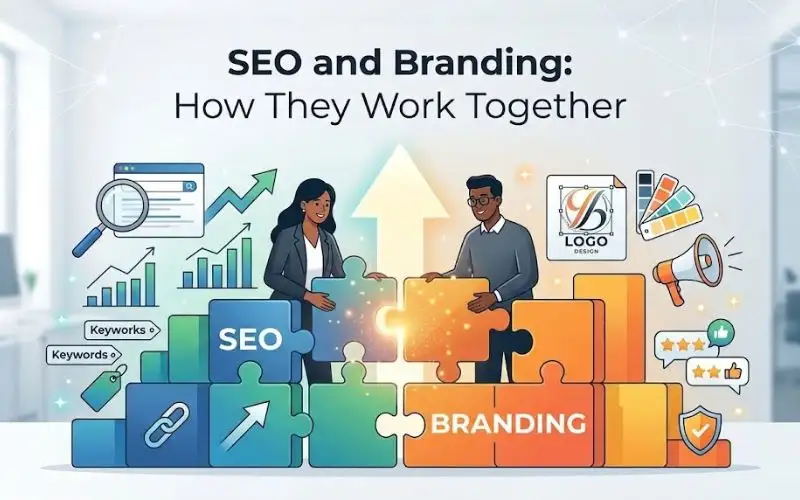
Your brand is no longer just a logo or a tagline. In the AI era, your brand is your most powerful SEO asset.
Think about that for a moment.
Traditional SEO taught us to chase keywords, build backlinks, and optimize meta tags. Those things still matter. But in 2026, the businesses that consistently appear in Google AI Overviews, ChatGPT answers, and Perplexity results share one common trait. They are trusted brands.
AI systems do not recommend unknown businesses. They recommend brands they can verify, confirm, and trust. If your brand lacks that digital credibility, no amount of keyword optimization will save you.
For local service businesses in Houston, this is both a challenge and an enormous opportunity. Most small businesses have invested nothing in brand building. That means the ones that start now can claim serious ground before the competition wakes up.
Let us get into it.
What Does Branding Mean for SEO?
Branding for SEO is not about design. It is about reputation, recognition, and trust signals that search engines can measure.
Here is a simple framework to understand it. Brand affects awareness. Awareness drives branded searches. Branded searches send powerful trust signals to Google. Those trust signals improve your rankings across both branded and non-branded keywords.
Every time someone in Houston types “Wise Car Care oil change” instead of just “oil change near me,” that branded search tells Google something important. Real people are looking for this specific business by name. That kind of intentional search is a strong signal of brand authority.
Award-winning SEO consultant Aleyda Solis was asked what the most underrated SEO tactic is. Her answer: “Probably building a brand.” That quote has held up consistently as SEO has evolved into the AI era.
In 2026, branding is not supplementary to SEO. It is the foundation.
How AI Search Engines Evaluate Your Brand
This is the part that most branding and SEO articles miss entirely. AI search engines like ChatGPT, Google AI Overviews, Perplexity, and Microsoft Copilot operate differently from traditional search algorithms.
Traditional Google ranking algorithms evaluate links, keywords, page speed, and on-page signals. They look at your website and the sites that link to it. AI search engines do all of that and then add a crucial layer: entity recognition and brand authority.
Large language models (LLMs) are trained on enormous amounts of web content. That training gives them a sense of which brands are widely trusted, frequently discussed, and consistently recommended across the web. When someone asks an AI “who is the best HVAC company in Houston,” the AI does not just run a keyword search. It draws on patterns from everything it has been trained on.
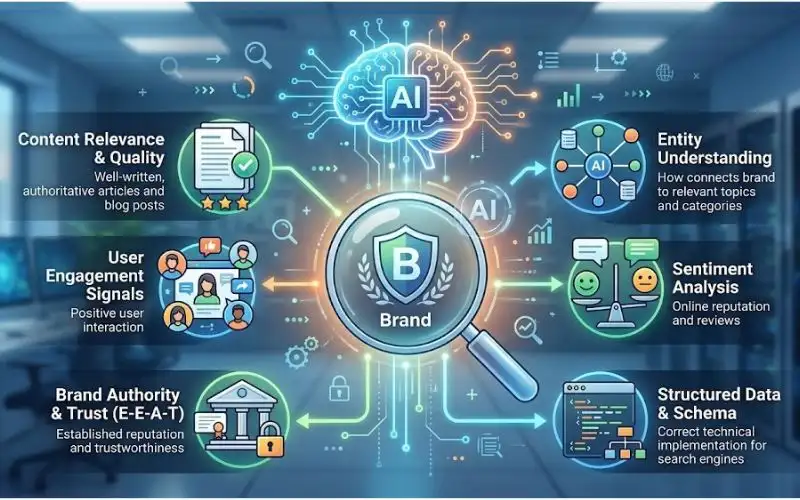
LLMs prioritize brand authority. To be featured in AI search results, you need to shift your focus from individual keywords to understanding entities. In the context of AI search, entities refer to specific brands, people, tools, or organizations that AI systems are designed to understand and prioritize.
For a plumbing company in Sugar Land, a dental practice in the Heights, or an auto repair shop in Katy, this means one thing. You need to become a recognized entity in your local market, not just a website with keywords.
There is a growing body of evidence that brand search volume and sentiment are strong predictors of AI visibility. If that trend continues, we will see brand authority play a major role in AI-driven rankings.
The 6 Ways Branding Directly Impacts Your SEO
1. Branded Search Volume Sends a Trust Signal to Google
When people search for your business name directly, that is called a branded search. It tells Google that real people know and want your business specifically.
A Houston HVAC company that generates consistent branded search volume is signaling something powerful. Real customers trust this company enough to search for it by name. That behavioral data feeds directly into Google’s ranking algorithms.
The more people search and engage with your brand online, the better your brand authority and the higher you will rank.
The Kleenex principle illustrates this perfectly. Nobody searches for “facial tissue.” Everyone searches for “Kleenex.” That branded dominance is the ultimate expression of brand-driven SEO power. And it scales down to every local market and every service category.
An auto repair shop in Houston that builds a strong enough local brand will see customers searching “Wise Car Care” instead of “auto repair shop near me.” That shift represents a fundamental upgrade in the quality of your search traffic.
2. Branding Improves Click-Through Rates on Search Results
Your listing appears in Google results. Someone recognizes your brand name. They click.
That recognition-driven click is more powerful than an accidental one. Research consistently shows that brand familiarity significantly increases organic click-through rates on search results pages. A higher click-through rate on your organic listing is a behavioral signal that tells Google your result is worth showing more often.
Conversely, an unknown brand name in a local search result gets scrolled past. The user clicks the competitor they have heard of. Google notices the difference and adjusts rankings over time accordingly.
3. Strong Brands Earn Backlinks Naturally
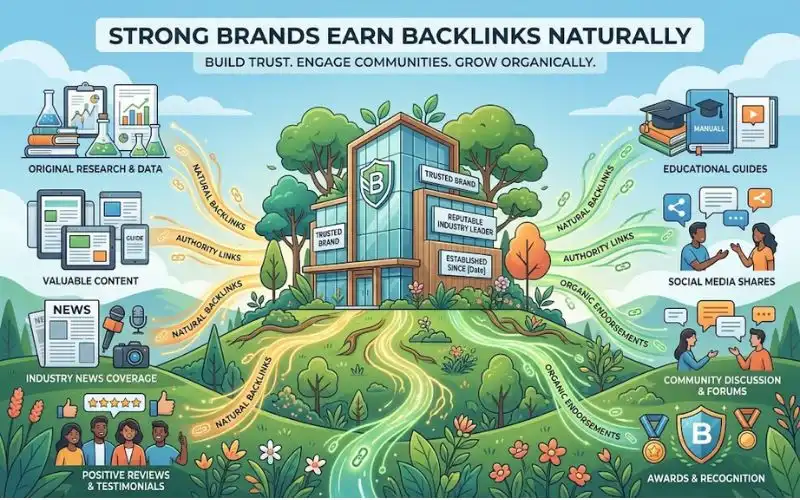
Link building is one of the hardest parts of traditional SEO. For businesses with strong brands, it becomes significantly easier. Brands with real reputations attract natural mentions, citations, and links from other websites without actively chasing them.
Developing a strong brand is, in a way, reverse engineering SEO. It helps to get a mass of people talking about your brand online in reviews, on social media, via citations, and in the form of backlinks. That conversation around your brand will signal to Google and other search engines your relevance in your specific market.
Natural backlinks from trusted, locally relevant sources carry far more SEO weight than paid link placements on generic directories. Branding is the engine that makes natural link acquisition possible.
4. Brand Authority Strengthens Your EEAT Profile
Google evaluates content and websites through its EEAT framework. EEAT stands for Experience, Expertise, Authoritativeness, and Trustworthiness. AI systems use similar criteria to decide whose content to cite and which businesses to recommend.
Traditional SEO signals like Google’s EEAT are not declining. In fact, it is the opposite. AI systems thrive on high-quality, context-rich signals when generating answers.
For local service businesses, EEAT signals look like this: a licensed plumber with a verifiable state license number on their website. A dental practice with credentialed practitioners named by name. An auto repair shop with ASE-certified mechanics listed prominently. These are not just trust signals for human visitors. They are entity signals that AI systems read to verify your brand’s legitimacy.
The more your brand is associated with verified credentials, real team members, consistent reviews, and authoritative mentions, the stronger your EEAT profile becomes. And a stronger EEAT profile means better organic rankings and more frequent AI citations.
5. Branded Content Drives Better User Behavior Signals
Brands that people recognize and trust generate different user behavior than unknown businesses. Visitors who recognize your brand spend more time on your site, visit more pages, and bounce less often.
These behavioral signals, including dwell time, pages per session, and bounce rate, are among the most important implicit ranking signals Google measures. A branded user experience naturally generates better behavioral data than a cold, unfamiliar one.
6. Consistent Branding Strengthens Local Citation Signals
Local SEO runs on citation consistency. Your business name, address, and phone number must appear consistently across Google, Yelp, Better Business Bureau, Angi, Apple Maps, and dozens of other directories. Inconsistency in your business name damages your local rankings.
This is a branding issue as much as it is a technical SEO issue. A business that has a clearly defined, consistently used brand name will naturally maintain cleaner citation data. Businesses that rebrand frequently, use abbreviations sometimes, or list slightly different name variations across directories create citation confusion that depresses local rankings.
For our SEO services clients, citation cleanup is one of the first technical wins we deliver. It is also one of the most direct connections between brand discipline and local search performance.
Branding and AI Search: What Is Different in 2026
The relationship between branding and SEO is not new. What is new in 2026 is how dramatically AI search has amplified the importance of brand signals.
In traditional search, Google could rank your page based primarily on content and backlinks. A page with the right keywords and enough links could outrank a well-known brand in many cases. AI search has changed this dynamic in a fundamental way.
AI search elevates brand reputation, mentions, and authority over traditional SEO tactics. PR-driven mentions in high-authority media influence both human readers and AI training models.
When a Houston homeowner asks ChatGPT “which plumbing companies in Houston are most reliable,” the AI’s answer is based on patterns across thousands of web sources, reviews, mentions, and editorial content. It will name the brands that appear most consistently and most positively across those sources. A plumbing company with 200 Google reviews, consistent media mentions, and a strong local web presence will get cited. A company with a keyword-optimized website but no brand presence will not.
Over 61% of AI mentions about corporate reputation come from earned media. That number climbs even higher when it comes to topics like trust or brand values.
Over 75% of brand mentions in AI-generated responses come from editorial media and social conversations, not a company’s own website.
This is a critical insight. Your own website is not the primary source AI uses to learn about your brand. The web around your brand is what AI reads. Reviews, news mentions, directory listings, social content, and community discussions all feed the AI’s understanding of who you are and whether you can be trusted.
How Local Service Businesses Build Brand Authority for SEO
Building a nationally recognized brand requires enormous resources. Building a locally authoritative brand in Houston, Katy, Sugar Land, or Spring is entirely achievable for a service business of any size. Here is how.
Earn Reviews Consistently and Strategically
Reviews are the most accessible and powerful brand-building tool available to a local service business. A Houston auto repair shop with 300 detailed, recent Google reviews is a recognizable local brand in the eyes of both customers and AI systems.
Ask every satisfied customer for a review. Send a direct link to your Google review page. Aim for steady review velocity every single month. Ten reviews this month are worth more than fifty from two years ago.
Get Mentioned in Local Media and Community Platforms
For Houston area service businesses, local media coverage creates powerful brand and SEO signals simultaneously. A mention in a Houston Chronicle neighborhood section, a feature on a local news website, or a spotlight in a community newsletter all carry real authority weight.
Reach out to local journalists and bloggers proactively. Offer to provide expert commentary on topics related to your service. An HVAC technician in the Heights who offers tips on summer cooling costs is a natural local media source. A Katy auto repair shop owner who explains Texas inspection requirements makes for a useful community resource piece.
These earned media mentions build your brand entity and create backlinks from locally trusted sources. Both outcomes directly improve your SEO.
Build a Consistent Visual and Messaging Identity
Brand consistency across every customer touchpoint creates recognition over time. Your logo, your color palette, your tone of voice, and your key messages should look and feel identical on your website, your Google Business Profile, your social media accounts, and your service vehicles.
A customer who sees your branded truck in the Katy neighborhood on Monday, finds your name on a community Facebook group on Tuesday, and then sees your Google listing on Wednesday is experiencing brand consistency. That consistency accelerates recognition and trust.
Consistent branding also reduces citation confusion for local SEO purposes. When every platform uses exactly the same business name, address, and phone number, your local citation signals strengthen and your rankings improve.
Create Content That Establishes Local Expertise
Content marketing builds topical authority. But for local service businesses, the most powerful content is content that establishes local expertise specifically.
A blog post titled “What to Do When Your AC Stops Working During a Houston Heat Wave” is not just a helpful resource. It is a brand signal. It tells every reader, and every AI system that indexes it, that your business understands the specific challenges of serving Houston area customers.
Content that references local landmarks, weather patterns, city-specific regulations, and neighborhood names signals local authority in a way that generic national content never can. A Sugar Land roofing company that publishes a guide to navigating Texas insurance claims after a hailstorm is building local brand authority that no competitor can easily replicate.
Leverage Social Proof Across Multiple Platforms
Social proof beyond Google reviews extends your brand footprint across platforms that AI systems also index. Yelp reviews, Facebook recommendations, Nextdoor mentions, and Angi ratings all contribute to the picture of your brand that AI systems develop.
Each platform where your business is positively represented is another data point for AI systems to draw on. A Houston plumbing company with 150 Google reviews, 80 Yelp reviews, and consistent Nextdoor recommendations has a richer, more verifiable brand profile than one with only Google reviews.
Why Your Google Business Profile Is a Brand SEO Signal
Your Google Business Profile is not just a directory listing. In the AI era, it is one of the most direct brand signals you can send to Google’s search and AI systems.
Google’s own data confirms that businesses with complete, active, photo-rich profiles receive dramatically more direction requests and website visits than businesses with incomplete profiles. These behavioral signals from GBP directly influence your local search rankings and your visibility in AI-generated local answers.
Your GBP profile communicates your brand identity to Google through every element:
- Your business name confirms your brand entity.
- Your business description signals your core services and values.
- Your photos show Google what your brand looks like in the real world.
- Your review responses demonstrate your brand voice and customer care standards.
- Your Google Posts signal that your brand is active and engaged.
- Your Q and A responses show expertise and customer orientation.
A GBP profile that is consistently updated, rich with original photos, and populated with thoughtful review responses is a brand-building exercise that also happens to be one of the most powerful local SEO tactics available.
Our Google Business Profile optimization services build your GBP into a brand asset that drives both local rankings and AI search visibility consistently.
How Branded Search Volume Predicts AI Visibility
This is one of the most forward-looking insights in modern SEO and AI search research. There is a direct relationship between branded search volume and how often a business gets cited in AI-generated answers.
There is growing evidence that brand search volume and sentiment are strong predictors of AI visibility.
When many people in Houston are searching for your business name directly, that behavioral signal tells AI systems that your brand has genuine recognition and trust in the local market. AI systems incorporate these behavioral signals into their recommendations over time.
The implication for local service businesses is powerful. Every marketing channel that builds brand awareness also builds your AI search visibility. A billboard campaign, a radio spot, a local sponsorship, or a neighborhood flyer drop all create brand impressions. Some of those impressions convert into branded searches. Those branded searches feed your AI visibility.
In the AI era, traditional brand marketing and digital SEO are no longer separate disciplines. They reinforce each other in a measurable and trackable way.
Common Branding Mistakes That Quietly Kill Your SEO
Inconsistent Business Name Across Platforms
Using “Joe’s Auto Repair” on Google but “Joe’s Auto Repair Shop” on Yelp and “Joe’s Auto” on Facebook creates citation inconsistency. This confuses Google’s local algorithms and weakens your brand entity signals. Pick one exact business name and use it identically everywhere.
Neglecting Your Online Reputation
A local business with a 3.2-star average rating has a brand problem that directly translates to an SEO problem. AI systems use sentiment and rating signals when evaluating which businesses to recommend. A low average rating, unanswered negative reviews, or a long gap in review activity all damage your brand authority in ways that affect your rankings.
Hiding Behind Generics
Service businesses that brand themselves around generic descriptions rather than distinct identities struggle to build brand recognition. “Houston Plumbing Solutions” is forgettable. A business with a strong name, a clear personality, and a memorable story builds brand equity that translates into search performance over time.
No Content Strategy
A website with only five pages and no ongoing content production cannot build topical authority or brand recognition in its market. Content is the primary mechanism through which your brand communicates expertise to both human audiences and AI systems. Without content, your brand is invisible beyond the immediate transaction.
Ignoring Local Community Presence
Local service businesses that exist only online miss the community presence that drives brand recognition in their service area. Sponsoring a Little League team in Katy, donating to a food drive in Spring, or participating in a Heights neighborhood association meeting all build local brand awareness. That awareness eventually converts into branded searches and organic brand mentions.
Conclusion
The era of purely technical SEO is not over. Keywords, site speed, schema markup, and link-building all still matter. But in 2026, the businesses winning in both traditional Google rankings and AI-driven search share a common foundation.
They are trusted brands.
They earn consistent reviews. They get mentioned in local media. Their business name appears identically across every platform. Their team is visible, credentialed, and human. Their content reflects genuine local expertise. Their Google Business Profile is active and photo-rich.
These are all brand activities. And every one of them is also an SEO activity.
For local service businesses in Houston, Katy, Sugar Land, Spring, and the Heights, building a recognizable local brand is now the most important SEO investment you can make. It is what creates the foundation that every keyword, backlink, and technical optimization builds upon.
The competition is not doing this yet. That window is open. But it will not stay open forever.
Ready to Build the Brand That Wins in AI Search?
At 4P Wisdom, we build brand and SEO strategies for local service businesses that want to dominate their market in 2026 and beyond. We combine review generation, content strategy, Google Business Profile optimization, citation management, and technical SEO into one unified brand authority system.
We serve businesses across Houston, Katy, Sugar Land, Spring, the Heights, and the surrounding areas.
If your brand is invisible online right now, we know exactly how to change that.