

Picture this. A driver in Houston feels a grinding sensation every time she brakes. She texts her coworker and asks if he knows a good mechanic nearby. He says, “Yes, try Riverside Auto on Westheimer. They are great.”
She takes out her phone. She does not call Riverside Auto.
She Googles it.
What she finds in the next 60 seconds will decide whether she books an appointment or quietly opens a second tab and picks someone else entirely. This is the moment where word-of-mouth ends and digital reality begins. For most independent auto repair shops, that moment is where they win or lose the customer.
Referrals are not dead. They are still one of the most powerful ways a new customer discovers your shop. But the referral no longer closes the deal on its own. Today, the recommendation starts the journey. Your online presence finishes it.
This guide explains exactly how that customer journey has changed, what drivers look for before they call, and what every auto repair shop owner needs to do to stay visible, trusted, and chosen in 2026.
Word-of-Mouth Still Works, But the Customer Journey Has Changed
Before the internet, a referral was enough. A customer heard your shop’s name from a neighbor, wrote down the number, and called. That was the entire process from discovery to decision.
That journey no longer exists.
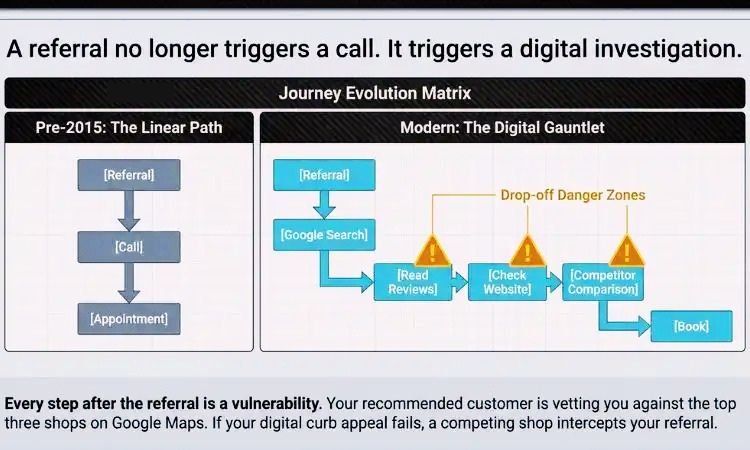
Today, the same referral triggers a digital investigation. The customer searches your shop name, reads your reviews, looks at your photos, visits your website, compares you against the top three shops appearing in Google Maps, and makes a decision. Sometimes that process takes two minutes. Sometimes it takes twenty. But it almost always happens before the customer ever picks up the phone.
Here is how the two journeys compare:
The old customer journey was simple. Referral, then call, then appointment.
The modern customer journey looks completely different. Referral, then Google search, then Google Maps, then reviews, then website, then social media, then comparison with other shops, then call or book online.
Every step after the referral is a moment where a competing shop can steal that customer. And
Your Best Referral Might Be Searching for You Right Now on Google
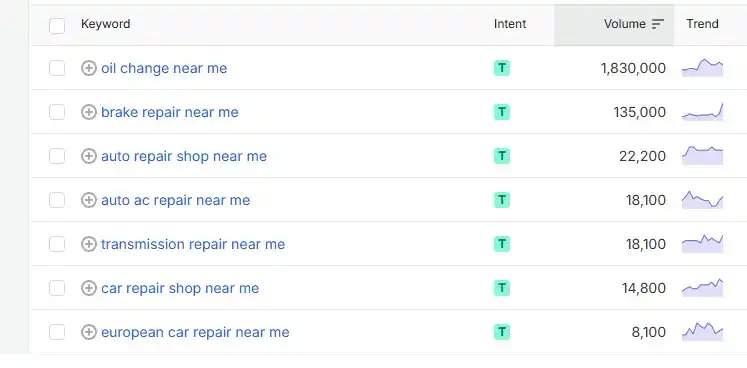
Here is a number that should change how you think about your marketing. Third-party keyword research datasets estimate that the search term “mechanic near me” receives approximately 752,500 searches per month across the United States. “Auto repair near me” generates around 340,100 monthly searches. “Auto repair shop” pulls another 74,000.
These are not people browsing for entertainment. These are drivers with a problem sitting in front of them right now. They are looking for a shop they can trust today.
Your current customers are not sending referrals to all of them. Nobody’s network reaches that many people. But your Google presence can.
If your shop is not ranking in the Google Map Pack for these searches, you are invisible to thousands of potential customers every single month in your own market. They are searching for exactly what you offer, right in your city, and choosing shops that show up while yours does not.
Word-of-mouth reaches the people who know someone who knows you. Search reaches everyone else. That second group is significantly larger than the first.
Here is another number worth understanding. Those keyword datasets show estimated cost-per-click values for these terms that reveal just how commercially valuable this search traffic really is. Advertisers pay around $5.90 per click for “auto repair near me” and around $6.31 per click for “brake repair.” Businesses only pay those amounts when they believe the person clicking is ready to spend money.
Search volume tells you how many people are looking. Cost per click tells you how valuable those people are. Together, they reveal a market your shop may be largely invisible to right now.
Customers Don’t Just Search for a Mechanic, They Vet Them
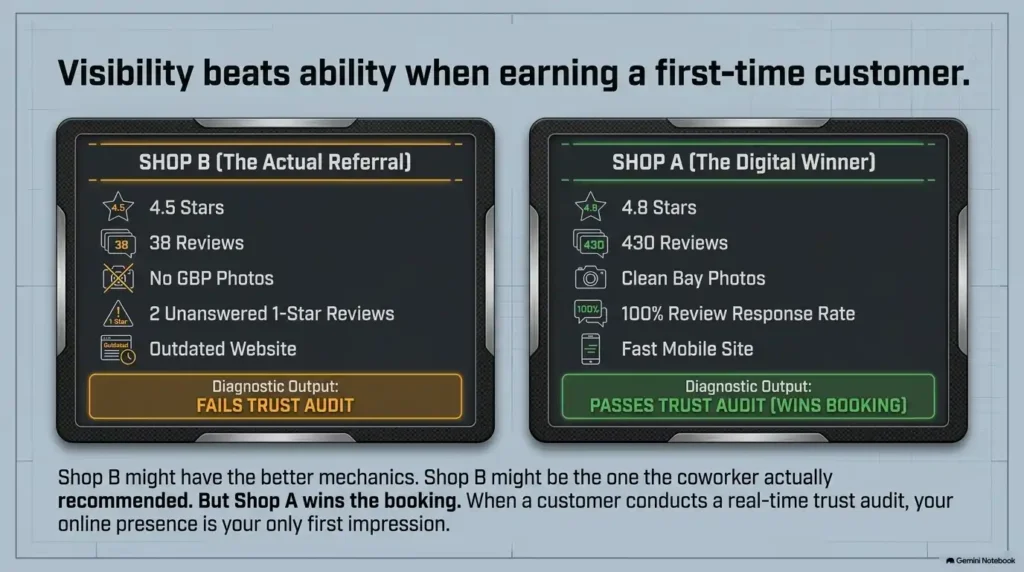
When a referred customer searches your shop name, they are not just confirming you exist. They are conducting a trust audit in real time. They are asking one question before they commit: does this shop look like somewhere I can trust with my vehicle?
Here is what they check in roughly this order.
They look at your star rating first. Then they check how many reviews you have. Then they read the most recent ones to see if anything worrying comes up. Then they look at your photos to see if the shop looks clean and professional. Then they click your website to check your services, your address, and whether you list your hours correctly. They also glance at whether the owner bothers responding to reviews at all.
Now consider two shops. Shop A has a 4.8-star rating with 430 reviews. The photos show clean bays, friendly technicians, and real before and after repair images. The website is clear and loads fast on mobile. The owner responds to every review, including the negative ones, with a calm and professional reply.
Shop B has a 4.5-star rating with 38 reviews. The website looks outdated. The Google Business Profile has no photos. There are two unanswered one-star reviews sitting at the top of the listing. The hours listed do not match the hours on the website.
Shop B may do better mechanical work. It may have the more experienced team. It may be the shop the customer’s coworker actually recommended. But Shop A wins the booking more often than not, because it looks more trustworthy to someone who has never been there before.
Your online presence is your first impression. For most new customers, it is your only first impression.
Your Google Reviews Are the New Word-of-Mouth
Think about what a traditional word-of-mouth referral sounds like. “My brother takes his truck there. They fixed his transmission in a day and did not overcharge him.”
That recommendation reaches maybe one or two people. It happens once, in a private conversation, and then it disappears.
Now think about what a Google review looks like. “This shop diagnosed my check engine light in under an hour, called me with a clear explanation, and had my car ready the same afternoon. Fair pricing and the technician walked me through everything. I will never go anywhere else.”
That review sits on your Google Business Profile permanently. It is visible to every person who searches your shop name. It influences every local customer deciding between you and three other shops. It works for you 24 hours a day without you lifting a finger.
Reviews are word-of-mouth at scale. A single happy customer who leaves a review is still talking about your shop years after their visit. A customer who tells their neighbor but never leaves a review stops influencing anyone the moment that conversation ends.
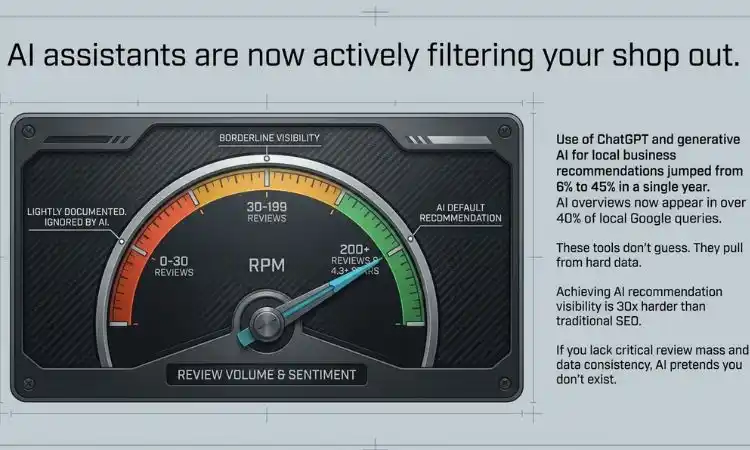
Google reviews are the threshold where AI tools begin treating a local business as well-established. Under 30 reviews, AI considers you lightly documented. Over 200 reviews with strong positive sentiment, you become a default recommendation.
This means your review count is not just a reputation metric anymore. It is a direct factor in whether AI tools recommend your shop when someone asks for help choosing a mechanic.
The shops winning the review game are not just doing better work than everyone else. They have a system. They ask every satisfied customer for a review within two hours of vehicle pickup. They make it effortless with a direct link sent by text. And they respond to every single review, positive or negative, within a day.
If your shop is generating 10 or fewer reviews per month right now, you are falling behind competitors who have made review collection part of their standard process.
Near-Me Searches Are Changing How People Find Auto Repair Shops
There is an important distinction between two types of people searching online right now.
The first person types “how often should I change my oil?” They are curious. They are researching. They are probably not booking an appointment today.
The second person types “auto repair near me.” They have a problem. They want it fixed. They are ready to call. That is a completely different level of intent, and it is worth understanding clearly.
Search intent tells you how close someone is to becoming a paying customer. Near-me searches come from people who have already decided they need service. They are only deciding which shop to call.
The auto repair shops ranking in the top three positions on Google Maps capture the majority of calls for any given local search. Independent shops that invest in their Google presence get the first visit, and in auto repair, the first visit turns into years of repeat business. If your shop is not in those top three positions for at least a handful of relevant local searches, the majority of near-me customers in your market are calling someone else. Not because your shop is worse. Because yours does not appear when they are looking.
Here is a simple but powerful way to think about the numbers. Imagine 1,000 drivers in your Houston neighborhood search for auto repair services in a given month. Of those 1,000, around 100 discover your shop through your Google listing. About 30 of those make contact. Roughly 15 book an appointment and become paying customers.
That is not a guaranteed funnel. It is an illustration of what local search visibility can look like when your online presence is working. Now imagine your shop is not ranking at all. That entire group of 1,000 local searchers never sees you. None of those 15 customers walk through your door. They walk through your competitor’s door instead.
Word-of-mouth did not reach those 1,000 people. Search could have.
The Biggest Mistake: Chasing Traffic Instead of Customers
Not all online visibility is created equal. Many shop owners hear the word SEO and assume the goal is to get as many website visitors as possible. That is not the right goal.
The goal is to get found by people who are ready to spend money on a repair right now.
This distinction matters enormously. Some search terms attract people who are months away from needing service. Others attract people who are sitting in a parking lot with a dead battery, trying to find someone who can help them within the hour.
Low-commercial-intent searches look like this. “How does a transmission work?” “Why is my car making a rattling noise?” “Car maintenance tips for beginners.” These are people researching, not booking.
High commercial intent searches look like this. “Transmission repair near me.” “Brake repair Houston.” “Auto repair shop near me.” “Car AC repair near me.” “Mechanic near me open today.” These are people ready to call.
A keyword with 500 monthly searches and strong buying intent can be worth far more to your shop than a keyword with 50,000 searches where most people are just curious. The shops that grow fastest through local SEO are the ones focusing on purchase-ready search terms in their specific market, not just broad traffic volume. Build your content and service pages around the searches that signal someone is ready to book. That is where your marketing investment delivers real, measurable return.
Word-of-Mouth Cannot Control What Customers Find About You
This is the part of the conversation that makes some shop owners uncomfortable. A referral can send a new customer to your door. But a referral cannot control what that customer finds when they look you up.
Your neighbor sends a new customer your way. That customer searches your shop name and finds a 3.9-star rating with two unanswered one-star reviews near the top. The shop photos show an outdated exterior taken years ago. The website loads slowly on mobile and lists phone numbers that no longer work. The hours on Google say you close at 5 PM, but your actual closing time is 6 PM. That referral did its job. It sent a potential customer your way. Your online presence did not do its job. It turned that customer away before they ever called.
Most independent auto repair shops list only “auto repair shop” as their Google Business Profile category, have no photos of the actual shop, and have a business description that could describe any mechanic in any city. Google has no reason to rank that listing above a competitor with a complete, detailed, and recently updated profile.
Every piece of information a potential customer can find about your shop online is either working for you or against you. Incorrect hours create frustration. Unanswered negative reviews signal indifference. No photos signal nothing about your quality or professionalism.
The good news is that every single one of these problems is fixable. And fixing them does not require a large budget. It requires attention and consistency.
AI Search Is Creating a New Layer of Visibility That Most Shops Are Missing
The way people find local businesses is changing in a new and significant way. It is no longer just Google Maps and Yelp. It is increasingly AI tools like ChatGPT, Google’s AI Mode, and other AI-powered search features that now actively recommend local businesses to people asking conversational questions.
Drivers are now asking things like “What is the best auto repair shop near me?” or “Who specializes in transmission repairs in Houston?” or “Can you recommend a trustworthy mechanic who works on Toyotas?” These questions used to go to a search engine. Now they increasingly go to an AI assistant.
Use of ChatGPT and other generative AI tools for local business recommendations rose from 6 percent to 45 percent in a single year, making it the third most popular source of business recommendations behind Google and Facebook.
That is a remarkable shift in a single year. And the AI tools recommending local businesses are not picking names at random. They are pulling from the same signals that local SEO has always depended on: review volume and quality, complete and consistent business information, active and authoritative online presence, and well-structured service pages.
Achieving AI local recommendation visibility is 30 times harder to accomplish than achieving traditional Google local search rankings. AI tools strongly favor businesses with high review ratings, averaging 4.3 stars for businesses recommended by ChatGPT.
This does not mean traditional local SEO no longer works. It means the bar has been raised. A shop that worked hard to rank on Google Maps two years ago now needs to ensure that same presence is built in a way that AI tools can understand, trust, and recommend.
Google AI Overviews appear in over 40% of queries related to local businesses. That means nearly half of all searches connected to your shop category may now surface an AI-generated summary before a customer ever reaches your website or Google listing.</cite>
Shops that have built a strong, accurate, and consistent digital presence across Google, Yelp, their website, and other directories are the ones AI tools recommend. Shops that have not built that foundation are invisible to a growing portion of the local search market.
What Auto Repair Shops Should Do Instead
Word-of-mouth and digital marketing are not competing strategies. They work together inside what you can call the Modern Auto Shop Visibility Stack.
Here is how the full stack works and what you should focus on at each level.
Level 1. Keep Delivering Exceptional Service
Every strategy in this guide starts here. Your work quality, your communication, and your honesty are what generate referrals and positive reviews in the first place. No amount of marketing fixes bad service. But great service with no marketing leaves enormous revenue on the table.
Level 2. Build a Complete and Active Google Business Profile
Your Google Business Profile is your most powerful free marketing tool. Claim it, complete every field, and keep it updated. List every service you offer as a separate service with its own description. Add real photos of your team, your bays, and your completed work. Post weekly updates about specials, hours changes, or new services. Respond to every review within 24 hours.
Level 3. Build a Systematic Review Generation Process
Ask every satisfied customer for a review within two hours of vehicle pickup. Send a text message with a direct link to your Google review page. Make it one tap to complete. Set a minimum goal of 10 new reviews per month, then increase it as your process matures.
Reply to every review. A thoughtful response to a negative review can actually build more trust than the negative review damages. Customers notice when a shop owner engages respectfully and takes feedback seriously.
Level 4. Invest in Local SEO and Dedicated Service Pages
Your website needs a separate page for every major service you offer. Not one giant “Services” page. Individual pages targeting searches like “brake repair Houston,” “transmission repair near Houston,” and “oil change Katy TX.” Each page should clearly explain the service, address common customer questions, and include a booking call to action.
Auto shops that invest in building out dedicated service pages often see call volume increase by 20 to 40 percent within the first few months as new pages begin driving targeted local search traffic.
Level 5. Build a Fast, Mobile-Friendly Website
Most drivers searching for a mechanic are on their phone. If your website takes more than three seconds to load on mobile, most visitors leave before reading a single word. Your website needs a tap-to-call button on every page. It needs your address, hours, and services visible without scrolling. It needs an online booking option that works at midnight when your front desk is closed.
Level 6. Create Social Proof Through Visual Content
Post real photos and short videos on Instagram and Facebook regularly. Before and after shots of completed repairs build trust faster than any written description. Show your technicians. Show your clean shop. Show your happy customers. These posts reach local drivers who may never have heard of your shop any other way.
Level 7. Make Your Online Presence AI-Ready
Ensure your business name, address, and phone number are identical across your Google Business Profile, your website, Yelp, Bing Places, Apple Maps, and every other directory where you are listed. This consistency is one of the core signals both Google and AI tools use to verify your shop’s legitimacy and relevance.
Write your website content in clear, conversational language that answers real customer questions directly. AI tools pull from well-organized, trustworthy web content when generating local business recommendations.
For a complete breakdown of lead generation strategies that work alongside these visibility tactics, read our guide on lead generation strategies for auto repair shops.
The Real-World Math Every Shop Owner Should See
Here is a simple way to understand the business case for everything covered in this guide.
Your shop currently generates 30 new customers per month through referrals. That is strong. But suppose 800 people in your Houston market search for auto repair services every month that you are perfectly positioned to serve. Your shop never appears in front of them because your Google presence is incomplete or your reviews are too few.
That means you are capturing 30 customers from a pool of 830 potential new customers. Word-of-mouth is reaching about 3.6 percent of your available market. A strong local SEO and review strategy can reach the other 96.4%
Even a modest improvement in search visibility, capturing an additional 15 new customers per month at a $300 average repair order, generates $4,500 in additional monthly revenue. That is $54,000 per year from customers who were already searching for exactly what you offer and simply could not find you.
This is not a complicated argument. It is just math.
Word-of-Mouth Isn’t Dead. It’s Just Digital Now.
Your customers are still talking about your shop. They are still telling friends, coworkers, and family members about the great experience they had. That has not changed.
What has changed is what happens next.
The friend they told Googles your shop. They read your reviews before they call. They look at your photos before they book. They compare your star rating against two other shops before they make a decision. And increasingly, they ask an AI assistant which shop in Houston they should choose.
Word-of-mouth gets you considered. Your online presence gets you chosen.
The shops filling their bays in 2026 are not only the shops with the best technicians. They are the shops that understood this shift early and built a digital presence that earns trust before a customer ever walks through the door.
Referrals are the starting line. Everything that happens online after the referral is the race.
Make sure your shop is set up to win it.
Ready to Turn Your Online Presence into Your Most Powerful Marketing Asset?
Your shop’s reputation is your most valuable asset. But that reputation only works for you if customers can find it, read it, and trust it before they call.
4P Wisdom is a Houston-based digital growth agency built specifically for auto repair shops. Our services cover every layer of the Modern Auto Shop Visibility Stack. We handle local SEO, Google Business Profile management, reputation management, Google Ads, website design, content marketing, and social media. Every strategy we build is custom to your shop, your market, and your revenue goals.
We do not guess at what works. We measure it. We track your rankings, your review growth, your call volume, and your new customer count every single month, so you always know exactly what is happening and why.
Get your free auto repair shop growth audit and discover exactly where your shop stands online today. You can also explore our proven auto repair marketing strategies or reach our team directly at info@4pwisdom.com or by phone at (346) 502-3315.
Your next customer is searching for you right now. Make sure they can find you.