

Artificial intelligence is rapidly changing the way content is created online, and YouTube is taking new steps to ensure viewers know when AI plays a role in the videos they watch.
The video-sharing platform recently announced updates to its AI disclosure system, including more prominent labels and automatic detection of undisclosed AI-generated content. The changes are designed to improve transparency while helping audiences better understand the origin of the content appearing in their feeds.
As AI-generated videos become increasingly realistic, distinguishing between human-created and AI-created content is becoming more difficult. YouTube’s latest update aims to address that challenge by making AI disclosures easier to see and harder to ignore.
YouTube Is Making AI Labels More Visible
One of the biggest changes is where AI labels will appear on videos.
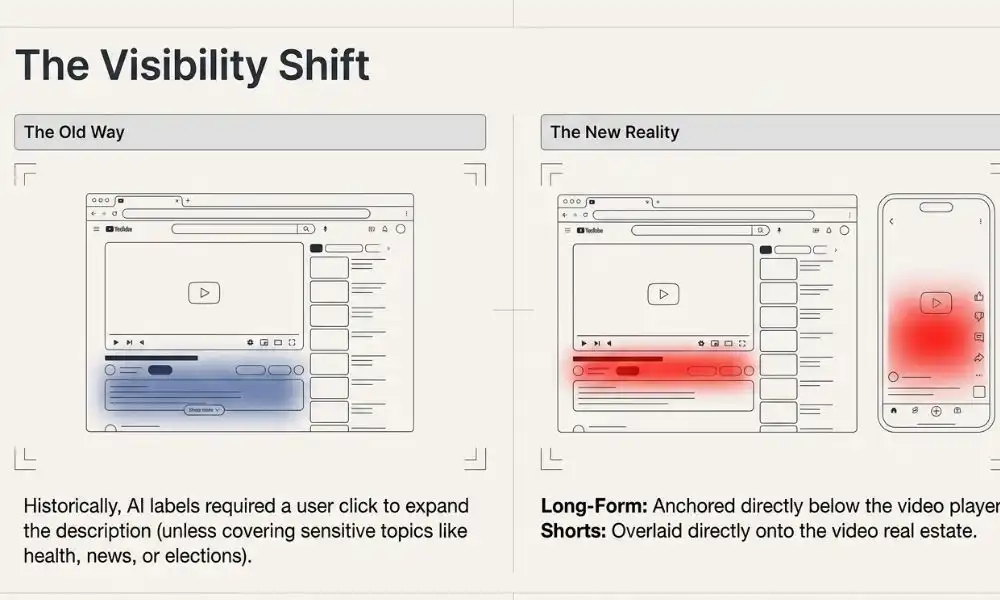
Previously, viewers often had to open a video’s description to see whether AI-generated content had been disclosed. As a result, many users never noticed these labels because they were hidden behind additional clicks.
With the new update, YouTube is moving AI labels to more visible locations.
For long-form videos, the disclosure label will now appear directly beneath the video player. On YouTube Shorts, the label will be displayed as an overlay on the video itself, making it visible while viewers watch.
This change represents a significant shift in how YouTube handles AI transparency. Instead of burying disclosures within descriptions, the platform is placing them front and center so viewers can quickly identify AI-generated content before deciding whether to continue watching.
According to YouTube Creator Liaison Rene Ritchie, the goal is simple: provide viewers with immediate context.
“If it looks real, but was made with AI, viewers will know immediately.”
Automatic Detection for Undisclosed AI Content
Alongside more visible labels, YouTube is introducing an automated detection system that identifies certain types of AI-generated videos.
Creators have already been required to disclose when they use AI to create realistic content. However, YouTube is now adding its own layer of verification.
If YouTube’s systems detect significant photorealistic AI-generated content that has not been disclosed, the platform may automatically add an AI label to the video.
This update is particularly important because AI tools are becoming more powerful and accessible. Anyone can now create highly realistic videos, images, and voice clones using generative AI platforms.
By implementing automated detection, YouTube hopes to reduce instances where creators fail to disclose AI-generated material, whether intentionally or accidentally.
However, YouTube has clarified that automated labeling does not replace the creator’s responsibility to disclose AI usage. Content creators are still expected to follow the platform’s disclosure requirements.
You can learn more about YouTube’s AI policies through the official YouTube Help Center:
The updates were outlined by YouTube Creator Liaison Rene Ritchie in a video accompanying the official announcement.
Creators Can Appeal Incorrect Labels
Like any automated system, AI detection technology isn’t perfect.
To address potential mistakes, YouTube is giving creators the ability to dispute labels they believe were applied incorrectly.
Through YouTube Studio, creators can request a review if they think their content was wrongly categorized as AI-generated.
This appeal process is important because some videos may contain advanced visual effects, CGI, or editing techniques that could potentially be mistaken for AI-generated content.
At the same time, certain AI labels will remain permanent.
Videos created using YouTube’s own AI tools, such as Veo and Dream Screen, will automatically receive AI labels. Likewise, content containing C2PA metadata that identifies it as AI-generated will retain those disclosures.
Will AI Labels Affect Video Rankings?
One of the biggest concerns among creators is whether AI labels could negatively impact their channel performance.
According to YouTube, the answer is no.
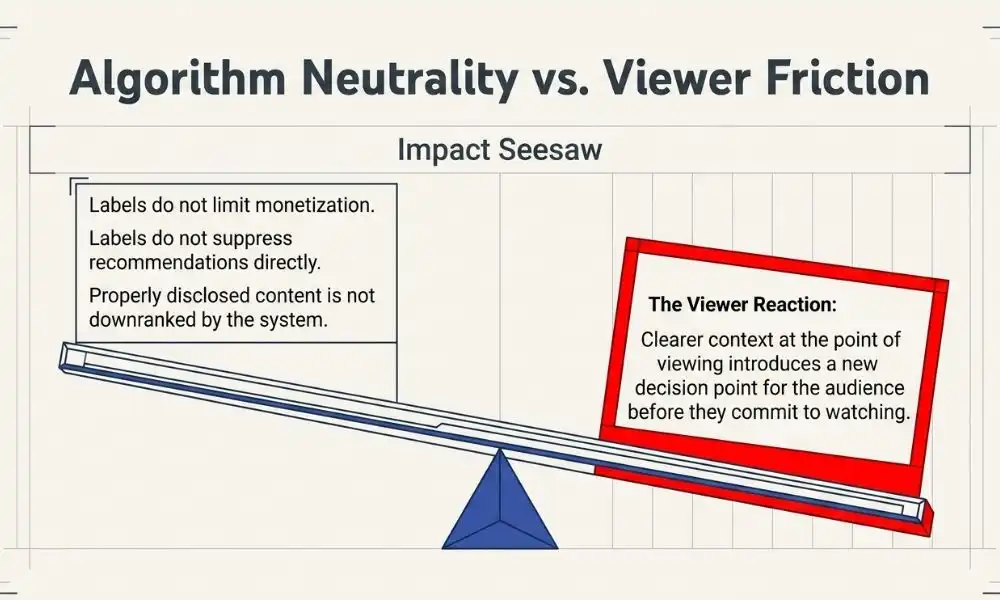
The company has stated that AI disclosure labels do not directly affect recommendations, search rankings, monetization eligibility, or ad revenue.
In other words, simply having an AI label attached to a video will not cause YouTube’s algorithm to suppress or penalize that content.
This reassurance is important for creators who use AI responsibly as part of their production workflow.
Many creators rely on AI for tasks such as:
- Script generation
- Voiceovers
- Video editing
- Thumbnail creation
- Translation
- Research assistance
YouTube appears to recognize that AI is becoming a standard tool for content creation rather than something that should automatically be viewed negatively.
However, there is an indirect factor worth considering.
While YouTube’s algorithm may not penalize AI-labeled videos, audience behavior can still influence performance. If viewers become less likely to click on AI-labeled content or spend less time watching it, those engagement signals could affect recommendations over time.
Ultimately, the success of AI-generated content may depend more on viewer preferences than on platform policies.
Why This Update Matters
The broader significance of this update goes beyond labels and algorithms.
Trust has become a major issue in the age of generative AI.
Today’s AI tools can create realistic faces, voices, environments, and even entire videos that are nearly impossible to distinguish from reality. While these capabilities open exciting, creative possibilities, they also increase the risk of misinformation, deception, and manipulated content.
By making AI disclosures more visible, YouTube is attempting to strike a balance between innovation and transparency.
Viewers gain additional context about what they’re watching, while creators can continue experimenting with new technologies without facing automatic penalties.
The update is particularly relevant for Shorts, where AI-generated content has grown rapidly in recent years.
Short-form video platforms reward speed, creativity, and high-volume content production—all areas where AI tools can provide significant advantages. As a result, AI-generated videos are becoming increasingly common across social media platforms.
Readers interested in broader discussions about AI-generated media can also review guidance from the National Institute of Standards and Technology (NIST):
What Happens Next?
The long-term impact of YouTube’s AI labeling system remains to be seen.
The platform has made it clear that labels are intended to inform viewers rather than punish creators. However, audience reactions could shape the future of AI-generated content on YouTube.
If viewers embrace AI-created videos, labels may simply become another piece of information displayed alongside titles and descriptions. If audiences become more selective about watching AI-generated content, creators may need to adjust their strategies accordingly.
What is certain is that transparency is becoming a priority across the digital content landscape.
As AI-generated media continues to evolve, platforms like YouTube will likely introduce additional tools and policies to help users understand how content is created. The latest update is another step toward building trust in an online environment where the line between human and machine-generated content is becoming increasingly blurred.
For creators, the message is clear: disclose AI use when required, stay informed about platform policies, and focus on creating content that provides genuine value to viewers regardless of whether AI is part of the production process.